Application Scenarios
A pharmaceutical packaging machinery builder had a persistent problem with its label applicators. Each machine had to handle a range of bottle diameters and label lengths, which meant constant changeovers, and the original architecture used a simple pulse-and-direction stepper drive driven by a small PLC. The PLC had to generate every step pulse, manage every sensor and handle every fault condition, so motion performance was tied to PLC scan time and any change in the motion profile meant a software download. Changeovers were slow, wiring was heavy, and the machines cost more to build than they should.
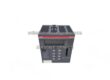
Re-architecting around the Pacific Scientific 6445-001-K-N removed the PLC from the motion path entirely. Because the 6445-001-K-N carries its own programmable indexer, the entire motion sequence for each bottle format could be written in Stepper BASIC and stored in the drive’s battery-backed RAM. Sensors, limit switches and start commands landed on the drive’s own 16 configurable inputs, while clamp and reject solenoids were driven from its 12 configurable outputs. The host system’s job shrank to selecting a recipe number over the serial link, and changeover became a single command rather than a programming session.
The deeper pain point the 6445-001-K-N addresses is architectural: in indexing applications, a separate controller plus a dumb drive costs more, wires longer and performs worse than one intelligent drive. Where the machine needs feed-to-length, label registration, shaft following or clutch-brake replacement, the Pacific Scientific 6445-001-K-N delivers the entire function in a single 6-pound package that mounts in the cabinet and holds its programme through a power cycle.
Parameter
| Main Parameters | Value / Description |
|---|---|
| Product Model | 6445-001-K-N |
| Manufacturer | Pacific Scientific (Danaher Motion legacy brand, now Kollmorgen) |
| Product Category | Indexer / microstepping stepper drive package, 6400 series |
| Input Power | 120/240 VAC switch selectable, +10% / -15%, 50/60 Hz single phase |
| Line Current at Full Load | 3.7 A RMS at 240 VAC, 4.7 A RMS at 120 VAC (300 W load) |
| Output Motor Phase Current | Adjustable 0.625 to 5 A RMS in 0.625 A steps via 3-position DIP switch; 5 A peak full step, 7.1 A peak microstepping |
| Drive Topology | Patented four-phase bipolar chopper, PWM current regulation, low ripple current |
| Microstepping Resolution | 200 to 51,200 steps per revolution with 1.8° motors, decimal step increments |
| Programming | Stepper BASIC, stored in 12 kB battery-backed RAM for parameters and move profiles |
| Communication | RS-232/485 port, single or multi-drop, 9600 baud |
| Digital I/O | 16 user-configurable inputs and 12 user-configurable outputs, compatible with 5 to 30 VDC |
| Output Sinking | Open-collector outputs, approximately 100 mA sink at 16 VDC |
| Encoder Interface | Quadrature encoder input with line-driver outputs for position verification, stall detection and electronic gearing |
| Auxiliary Supply | 66 VDC output (±3 V) to power an additional axis; combined internal plus external power 300 W ±10% |
| Protection | Over-temperature, short circuit, under-voltage, line-to-line, line-to-neutral and microprocessor fault protection |
| Environmental and Mechanical | Operating 0 °C to 50 °C at full load; storage -40 °C to 70 °C; internal cooling fan; approximately 6 lb (2.7 kg) |
Technical Principles and Innovative Values
Innovation Point 1: Digital Electronic Damping that recovers lost mid-range torque. Every open-loop stepper system suffers a mid-speed resonance band where torque collapses or the motor stalls. The Pacific Scientific 6445-001-K-N addresses this with a patented digital damping circuit that suppresses those oscillations, so full motor torque remains available across the whole speed range in both full-step and microstepping modes. The practical result is a stepper axis that can be driven through the speed band that normally forces designers to oversize the motor.
Innovation Point 2: A real indexer inside the drive, not just a pulse follower. The 6445-001-K-N stores and executes complete motion programmes on its own, using 12 kB of battery-backed RAM that survives power loss. That means move profiles, position tables and I/O sequencing live in the drive rather than in a separate controller. For machine builders this removes a component, removes a layer of wiring, and removes the PLC scan time as a limiting factor on motion performance.
Innovation Point 3: Microstepping up to 51,200 steps per revolution in decimal increments. Resolution on the Pacific Scientific 6445-001-K-N scales from a full-step 200 steps per revolution up to 51,200, in decimal rather than binary increments, which keeps engineering units intuitive. High resolution is what carries the axis smoothly through the low-speed resonance region where steppers are traditionally coarsest and noisiest, and it is why the 6445-001-K-N suits applications like optical positioning and precision indexing.
Innovation Point 4: Encoder feedback for verification without closing the loop. The 6445-001-K-N accepts quadrature encoder input and uses it for position verification and correction, stall detection and electronic gearing. This is a genuinely different proposition from a pure open-loop stepper: the drive can confirm that the move it commanded actually happened, detect a stall that open loop would never see, and follow a master axis electronically, while retaining the simplicity and cost profile of stepper hardware.
Innovation Point 5: Automatic idle current reduction plus an auxiliary axis supply. If no step command arrives for 0.1 seconds, the Pacific Scientific 6445-001-K-N automatically cuts motor winding current by up to 50 percent and restores it instantly on the next command. In dwell-heavy duty cycles this dramatically reduces motor heating and cabinet temperature. At the same time, the onboard 66 VDC output can power a second axis directly, so a two-axis machine can run from a single AC feed without a second power supply.