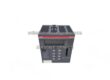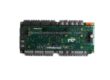
Application Scenarios:
A district heating plant runs a 1960s-vintage mechanical-hydraulic governor on its back-pressure steam turbine. The governor itself is sound — these things were built to outlive their designers — but the speed-setting motor drive had become erratic. Raise and lower commands from the control room would sometimes move the setting smartly, sometimes crawl, and occasionally not at all until an operator went out and tried again. Nobody could reproduce the fault on demand, and the plant had reached the point of assuming the governor needed rebuilding.
The root cause was in the drive, not the governor. The plant’s existing unit was a standard PM Motor Control, and that design has a known behaviour: when the mechanical load on the speed-setting motor varies — stiffer linkage, colder grease, a binding point in the travel — the output voltage shifts, and motor speed follows it. Under light load the motor ran fast; under load it crawled to a near-stall. And there was a second, compounding problem: the motor had been left stalled against a mechanical stop, which Woodward explicitly warns against, because a stalled PM motor will burn out either the motor or the control.
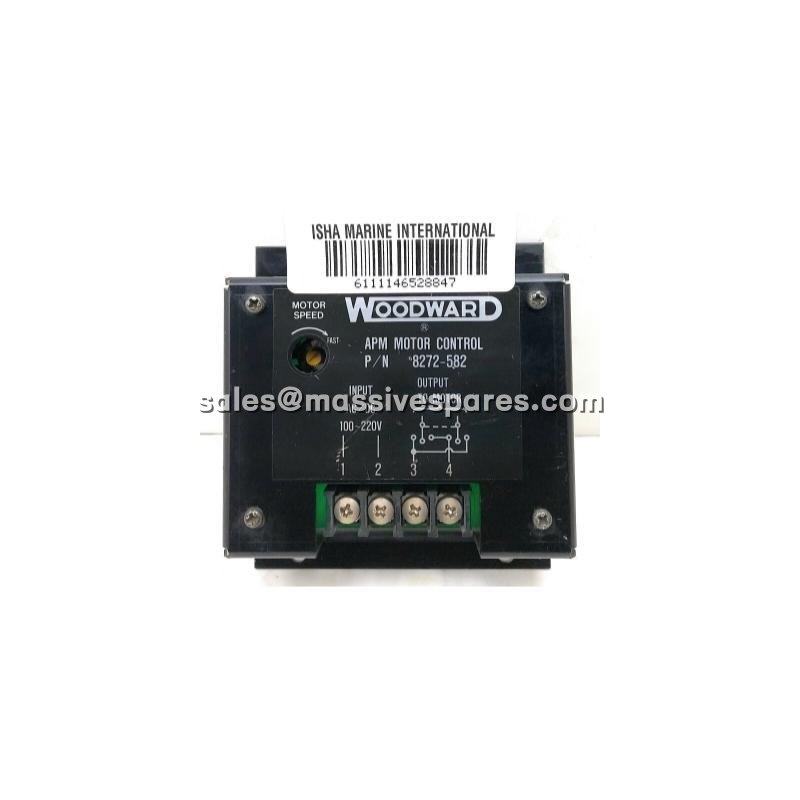
Fitting the 8272-582 addressed both. Because the APM regulates to hold motor speed constant as load changes, the raise/lower rate stopped wandering and became consistent through the full travel. And because the on-board potentiometer sets the rate directly, the commissioning engineer simply dialled in a sensible ramp — in this case slower than the original, so the speed setting could no longer be driven hard against its stops. The turbine became predictable from the control room again, at the cost of one small module rather than a governor overhaul.
This is the pattern wherever these units are used: industrial steam turbines, small turbo-generators, turbo-expanders, diesel and gas genset prime movers, marine propulsion and auxiliary engines, and any installation where a mechanical-hydraulic governor of the UG, SG, PSG or 3161 type still governs a machine that is expected to keep running.
Parameter:
| Main Parameters | Value/Description |
|---|---|
| Product Model | 8272-582 |
| Manufacturer | Woodward |
| Product Category | APM (Advanced Permanent Magnet) Motor Control — speed plate / drive module for governor speed-setting motors |
| Input Voltage | 100–220 VAC/VDC universal (a 24 VDC ±10 % variant also exists in the APM family) — one part number covers most plant supplies without a tap or regional variant |
| Output Drive Voltage | 0–24 VDC adjustable; recommended operating range 10–24 VDC for the PM motor |
| Maximum Output | Up to 4 V below input voltage — a hard ceiling to respect when setting the potentiometer |
| Loaded Motor Speed | Held constant as motor load varies — the defining behaviour of the APM versus a standard PM Motor Control |
| Speed Rate Adjustment | Single on-board potentiometer; clockwise for faster speed-reference change, counter-clockwise for slower |
| Direction Control | Motor rotation reversed by swapping the output leads; requires a double-pole, double-throw switch in the output line |
| Governor Compatibility | Speed raise/lower mapping defined per governor type — UG (Lower = A-A’, Raise = B-B’) and SG, PSG, 3161 (Lower = B-B’, Raise = A-A’) |
| Motor Wiring | Sawamura: red to B-A’, black to A-B’; Pittman: red to A-B’, black to B-A’ — verify against the motor nameplate |
| Construction & Mounting | Metal mounting plate that doubles as the heatsink, four fixing holes, cabinet or panel mounted; compact form factor |
| Cooling | Passive, via the metal mounting plate — no fan, no filter, nothing to maintain |
| Operating Temperature | −20 °C to +60 °C typical for this class of control (some sources cite −40 °C to +70 °C); storage −40 °C to +85 °C |
| Protection | Over-voltage and short-circuit protection on the module; do not stall the motor, as this can burn out the motor or the control |
| Compliance | Meets RoHS 2015 criteria; CE applicable at system level; designed and manufactured in the USA |
| Replacement Policy | Order by the part number on the nameplate; parts are not available separately and Woodward recommends complete replacement if a controller failure is found |