Description
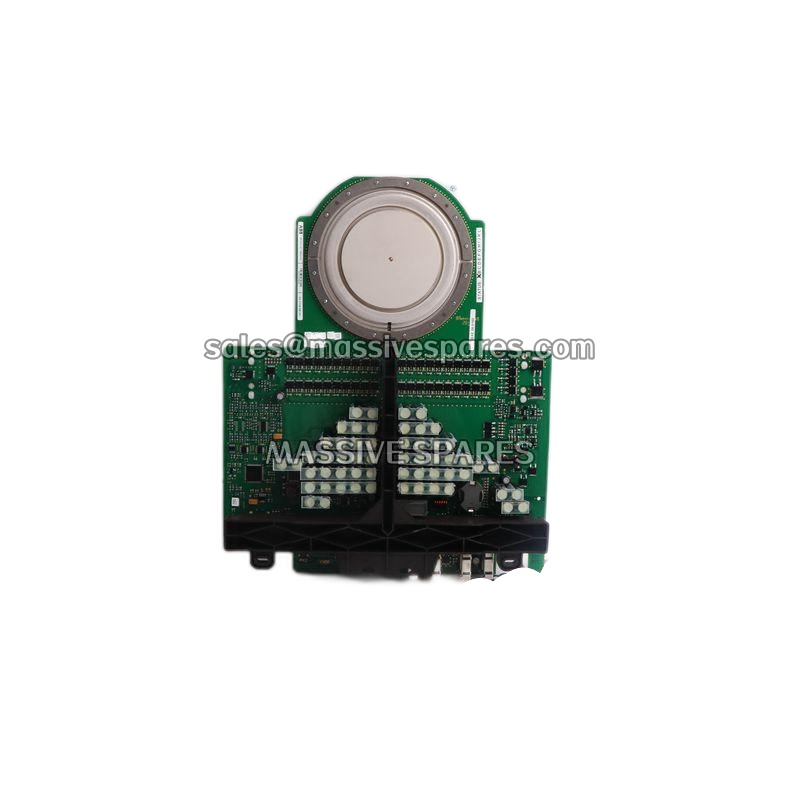
Technical Specifications
| Parameter | Value |
|---|---|
| Product Model | 3BHE028761R0102 |
| Board Identification | GDC806A102 (GD C806 A102) |
| Manufacturer | ABB (Switzerland / Sweden) |
| Product Type | Gate Driver Control & Interface PCB Card (VBE / PBA rack) |
| Compatible Systems | ABB ACS6000, ACS6000C, ACS2000 MV drives; UNITROL 6000 excitation; AC 800PEC / PEC80x; SVC Light, STATCOM |
| Upstream Companion | COB 3BHE014967R0002 or interface board 3BHE025883R0001 |
| Paired Assembly | 3BHE033675R0201 (GVC736-series control/interface, flat-cable linked) |
| Control Supply | ±15 V DC from cabinet control supply, tolerance ±10% |
| Auxiliary Supply | 24 V DC, typical; power dissipation ≤10 W |
| Signal Interface | Multi-channel fiber-optic receive (trigger) / transmit (feedback) to COB; 660/820/1300 nm multimode, ST or SMA |
| Gate Output | ±15 V shaped pulse, guaranteed minimum on-time, dead-time transparent pass-through |
| Isolation | ≥15 kV (optocoupler + pulse transformer dual isolation, IEC 60700) |
| Protection Functions | BOD overvoltage detection, Desat monitoring, TCM turn-on confirmation, UVLO, NTC temperature sense, watchdog, hardware Pulse Block |
| Response Time | Fiber-in to gate-out delay <1 µs |
| Substrate | Multilayer FR-4, UL 94-V0, impedance-controlled traces, ENIG pads |
| Surface Finish | Conformal coating, G3 corrosion class (ANSI/ISA 71.04), R0102 suffix |
| Status Indication | 1–2 on-board LEDs (PWR / ERR / ACT, decoded per slot) |
| Mounting | 3U plug-in Eurocard, vertical insertion into GUSP gate-unit housing or dedicated PBA rack slot; slot coding A/B/C/D |
| Operating Temperature | -20 °C to +60 °C (cabinet forced ventilation) |
| Storage Temperature | -40 °C to +85 °C |
| Relative Humidity | 5 %–95 % RH, non-condensing |
| Dimensions (approx.) | 280 × 180 × 30 mm (W × H × D, variant-dependent) |
| Net Weight | ≈0.55–0.75 kg |
| Protection Rating | IP20 (control-cabinet use) |
| Certifications | CE, UL, IEC 61800-5-1, IEC 60700, IEC 61000-4-x EMC, RoHS |
Main Features and Advantages
Sub-microsecond deterministic gate drive. The defining capability of the ABB 3BHE028761R0102 is the predictability of its signal path. Trigger pulses arrive as light, are decoded by the on-board FPGA/ASIC layer, and emerge as ±15 V gate pulses in less than 1 µs total latency. In a six-pulse bridge switching at several kilohertz, that determinism fixes the commutation overlap and prevents cross-arm shoot-through during load transients—the single most expensive failure mode in a multi-megawatt converter.
Hardware-level protection, independent of software. Generic gate drivers amplify. The ABB 3BHE028761R0102 decides. Its BOD circuit watches the IGCT anode for overvoltage, the Desat comparator monitors collector-emitter (or anode-cathode) voltage during conduction, and the TCM circuit confirms that turn-on actually happened. All three, plus UVLO and overtemperature, converge on a hardware Pulse Block line that kills the gate output faster than any firmware loop. The consequence is that a shorted semiconductor is stopped before it becomes an exploded one.
Dual isolation to ≥15 kV. Control electronics and a several-kilovolt switching node do not belong in the same potential domain. The ABB 3BHE028761R0102 separates them with both an optocoupler and a pulse transformer, satisfying IEC 60700 for high-voltage DC equipment. The fiber interface removes the common-mode path entirely; the pulse transformer handles the gate charge. The result is a card that survives the dv/dt and stray discharge that burn ordinary interface boards.
Diagnostic return path that tells the truth. Every ABB 3BHE028761R0102 ships fault, overtemperature, and conduction-status back to the VBC on dedicated feedback fibers. During a trip, the maintenance team does not guess whether the issue is the COB, the gate driver, the GUSP, or the IGCT—the fault word identifies the layer. This is the difference between a four-hour strip-down and a twenty-minute board swap.
Environmental hardening matched to the cabinet. The R0102 build carries a conformal lacquer over military-grade SMD components and gold-finger backplane contacts. It is rated for G3 corrosive atmospheres (salt, H₂S, SO₂, coastal and pulp-mill air), -20 °C to +60 °C operation, and 95 % non-condensing humidity. The ABB 3BHE028761R0102 is therefore a credible fit for offshore platforms, mine hoists, cement kilns, and paper-machine winders—places where “spare on the shelf” is the only acceptable failure mode.
Serviceable by design. The card is a 3U Eurocard with an ejector clip and coded slot keying, so replacement is a plug-and-play event rather than a rewire. Field evidence shows that boards with clean gold fingers and intact coating usually self-initialize after re-insertion without firmware reload, provided the rack BOM and slot position are respected.