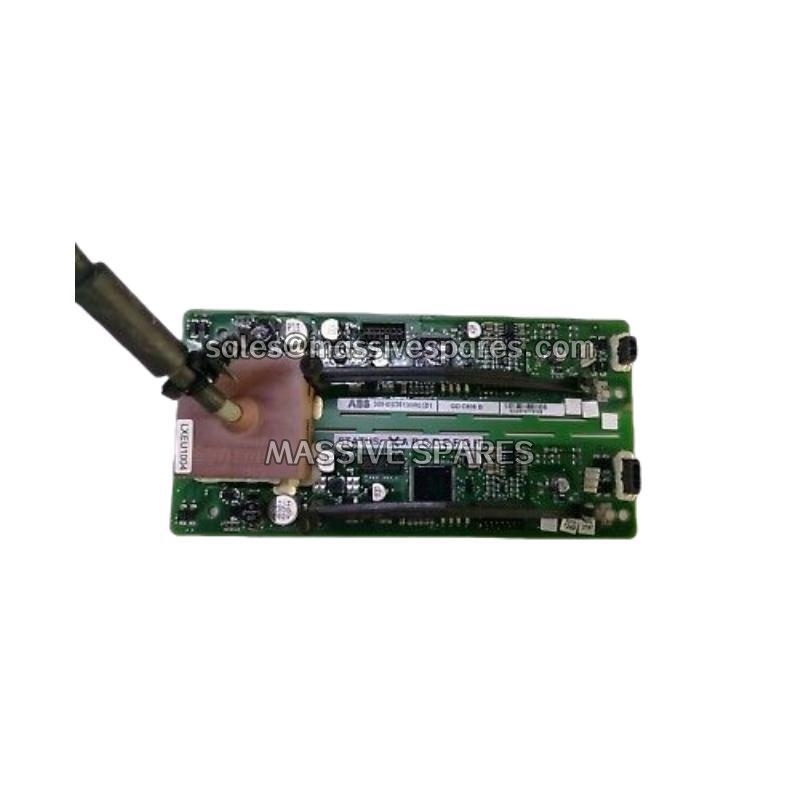
Description
Application Scenarios
In a coastal petrochemical facility, a 2.5 MW ACS2000 variable frequency drive powers an induced draft fan for a catalytic cracking unit. During a thunderstorm, a lightning-induced transient causes a momentary phase-to-phase fault within the motor winding. The 3BHE036130R0101 detects the desaturation event within approximately 1–2 microseconds of turn-on — far faster than the drive controller’s sampling cycle — and pulls the IGBT gate low before the fault current can destroy the module. Without this board’s autonomous protection capability, the 2000A IGBT would rupture, the DC link fuse would blow, and the refinery would face an 8-hour unplanned outage. With the 3BHE036130R0101 acting as the intelligent gatekeeper, the fault is contained, the power module survives, and production resumes within the hour.
Parameters
| Parameter | Value/Description |
|---|---|
| Product Model | 3BHE036130R0101 (GDC806B) |
| Manufacturer | ABB |
| Product Category | IGBT Gate Drive Control Board (PCB Assembly) |
| Compatible Platforms | ACS2000 medium-voltage drives (250 kW–3.68 MW), AC 800PEC architecture |
| Gate Output Voltage | ±15 V typical (configurable per IGBT module rating) |
| Peak Drive Current | Tens of amperes (short-pulse, turn-on/turn-off) |
| Auxiliary Supply | 24 V DC from gate-unit PSU |
| Signal Input | Fiber-optic RX from controller/PEC CPU |
| Communication (Diagnostics) | Dual Ethernet ports, Modbus TCP, IEC 61850-9 (per ACS2000 platform) |
| Protection Features | Desaturation (Vce) detection, UVLO, short-circuit, Miller clamp |
| Response Time | Nanosecond-level fiber-to-gate propagation |
| Operating Temperature | -40°C to +70°C |
| Mounting | Gate-unit compartment PCB card mount |
| Protection Class | IP20 (board-level, enclosed within drive cubicle) |
Technical Principles and Innovative Values
- Desaturation Monitoring with Blanking-Time Intelligence: A raw overcurrent comparator on an IGBT would false-trip every switching cycle because collector-emitter voltage naturally sits high for several hundred nanoseconds during turn-on. The 3BHE036130R0101 embeds a configurable blanking interval after each turn-on edge, then samples Vce during the on-period. If Vce fails to drop below the desaturation threshold — indicating a shorted load or failed device — the board pulls the gate low within <5 µs and sends a fiber-optic fault signal upstream. This is the difference between an IGBT surviving a fault and a power module punching through.
- Miller Clamping for dv/dt-Induced False Turn-On Prevention: In high-power IGBT bridges, rapid voltage transitions across the collector-emitter path can capacitively couple through the gate-collector capacitance (Miller capacitance) and induce a spurious gate voltage. The 3BHE036130R0101 actively clamps the gate to the emitter during off-state intervals, preventing parasitic turn-on that would create a shoot-through condition and destroy both upper and lower IGBTs in a bridge leg.
- Fiber-Optic Isolation for Harsh Electrical Environments: The board communicates with the drive controller exclusively through fiber-optic links, eliminating galvanic paths between the high-voltage power section and the low-voltage control electronics. This isolation architecture is not merely a convenience — it is essential for surviving the electromagnetic interference and common-mode voltage swings present in medium-voltage drive cabinets, where ground potential differences can exceed thousands of volts during switching events.