
Description
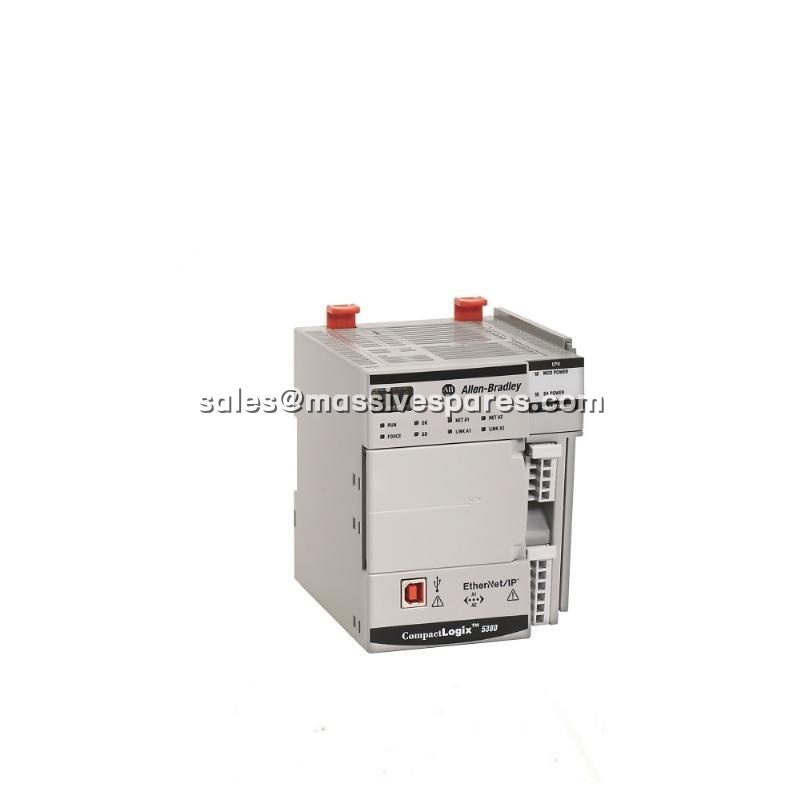
Application Scenarios
Consider a mid-sized packaging machine builder that has been shipping a horizontal flow-wrapper for years with a 1769-L33ER plus a separate motion module. The platform is now the constraint: the new generation of machines needs eight coordinated servo axes, vision-triggered registration, recipe management, and a data feed to the customer’s MES — all inside the same panel footprint.
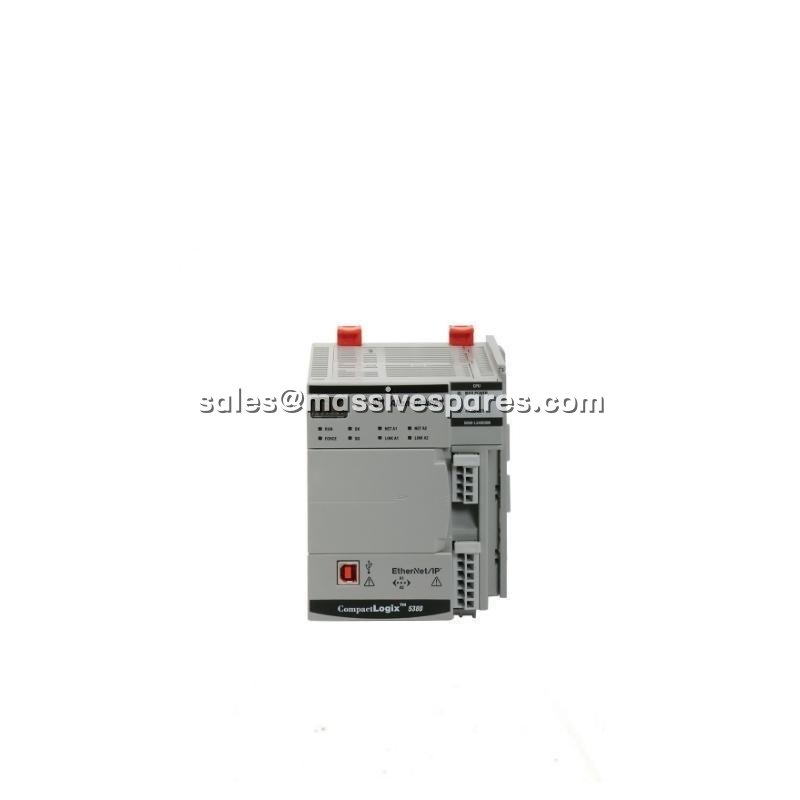
This is the exact profile 5069-L320ERM was built for. Integrated motion over EtherNet/IP removes the separate motion card entirely, so eight Kinetix drives hang off the same network as the I/O and the HMI. The two gigabit ports allow a clean split: a machine-level Device Level Ring for drives and remote I/O, and a separate link to the plant network, without adding a managed switch purely for segmentation. When the end customer later asks for an extra conveyor section, the 16-module local I/O capacity and 40-node EtherNet/IP budget absorb it without a controller change.
The pain points it solves consistently: panel space (rackless DIN-rail design), motion and logic living in two different programming environments, network segmentation requiring extra hardware, and the awkward jump to ControlLogix whenever axis counts grow past four. For a converting line running register-controlled knife and seal jaws, 5069-L320ERM delivers CIP Motion synchronisation and the logic in one project, one download, one diagnostic view.
Parameter
| Main Parameters | Value/Description |
|---|---|
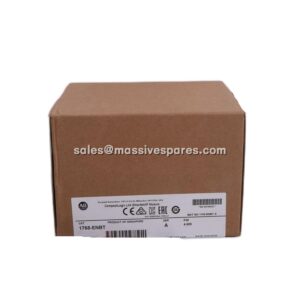
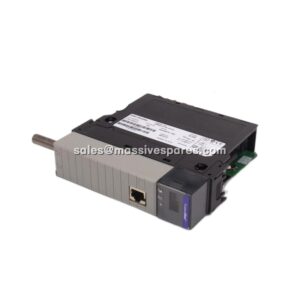
| Product Model | 5069-L320ERM |
| Manufacturer | Allen-Bradley / Rockwell Automation |
| Product Category | CompactLogix 5380 PAC with integrated motion (standard, non-safety controller) |
| User Memory | 2 MB — sized for multi-axis motion plus recipe, diagnostic and communication logic |
| Non-Volatile Memory | 2 GB SD card (1784-SD2, included); supports up to 32 GB for program backup and restore |
| Processor | Quad-core — separates motion, logic and communication workload |
| Integrated Motion | 8 CIP drive axes — servo control over the same EtherNet/IP network as I/O |
| Local I/O Capacity | Up to 16 Compact 5000 (5069) I/O modules on the high-speed backplane |
| EtherNet/IP Nodes | Up to 40 devices with Studio 5000 Logix Designer v31 or later |
| Communication Ports | 2 × 1 Gb EtherNet/IP (10/100/1000 Mbps, full duplex) + 1 × USB 2.0 Type B (12 Mbps) |
| Network Topologies | Device Level Ring (DLR), Linear, Star; Dual-IP mode for machine/plant network separation |
| Sockets / Message Rate | 32 sockets; up to 2,000 messages/s (1,500 with CIP Security integrity, 900 with integrity + confidentiality) |
| Power — MOD | 18…32 V DC, 450 mA max, inrush 850 mA for 125 ms; passthrough 9.55 A |
| Power — SA | 0…32 V DC or 0…240 V AC, 47…63 Hz (ATEX/IECEx: 125 V AC max); passthrough 9.95 A DC / 9.975 A AC |
| Power Dissipation | 8.5 W (29 BTU/h) — simplifies thermal budgeting in sealed panels |
| Isolation | 300 V continuous, basic/double insulation; type-tested at 1500 V AC for 60 s |
| Programming Languages | Ladder Diagram, Function Block Diagram, Structured Text, Sequential Function Chart |
| Tasks | 32 tasks, up to 1,000 programs per task |
| Environmental | 0…60 °C operating, –40…85 °C storage, 5–95% RH non-condensing; 30 g shock, 5 g vibration |
| Installation Method | Horizontal DIN rail, EN50022 — 35 × 7.5 mm (zinc-plated steel for reliable grounding) |
| Dimensions / Weight | 143.97 × 98.10 × 136.81 mm (H × W × D); approx. 0.77 kg |
| Certifications | CE, UL/cUL, KC, RCM, ATEX, IECEx, China CCC, RINA; lifecycle status Active |
Technical Principles and Innovative Values
Innovation Point 1: Motion on the I/O network, not beside it. 5069-L320ERM runs CIP Motion over standard EtherNet/IP, so servo drives, remote I/O, HMI and safety devices share one cable plant. There is no separate motion bus, no SERCOS fibre, and no second configuration tool. CIP Sync (IEEE 1588) time-stamps every node to a common clock, which is what makes multi-axis interpolation repeatable rather than approximate.
Innovation Point 2: Dual gigabit ports that actually change the architecture. The two ports can run in Dual-IP mode — physically separating machine traffic from enterprise traffic — or participate in a Linear/DLR topology under a single IP address. That is the difference between adding a managed switch for segmentation and not needing one, and DLR gives a self-healing ring where a single cable break does not stop the machine.
Innovation Point 3: Rackless, MOD/SA split power design. 5069-L320ERM clips directly to a DIN rail and builds its I/O bank sideways, eliminating the backplane, the rack and the associated depth. Internally it separates MOD power (logic and backplane) from SA power (field-side sensors and actuators), so a field-side short or a noisy solenoid bank cannot brown out the processor.
Innovation Point 4: Quad-core headroom with security built in. Unlike older single-core compact controllers, 5069-L320ERM has four cores to absorb motion planning, logic scan and communication simultaneously. It also supports CIP Security, with controller-based change detection and logging — so unauthorised program changes are recorded, which matters for regulated industries and for OEMs protecting machine IP.
Innovation Point 5: A genuine migration path, not a fork in the road. Because 5069-L320ERM shares the Logix 5000 instruction set and the Studio 5000 environment with CompactLogix 5370 and ControlLogix 5580, existing ladder, add-on instructions and motion code port across. The 2 GB SD card (expandable to 32 GB) also makes firmware and programme recovery a field-replaceable task, not a service call.
Innovation Point 6: Right-sized capacity that avoids the ControlLogix jump. At 16 local modules, 40 nodes and 8 axes, 5069-L320ERM covers the band where CompactLogix 5370 ran out of room. Machine builders stay on the compact platform — smaller panel, lower cost — instead of oversizing into a 1756 chassis simply to gain a few axes.