
Description
Application Scenarios:
It is 03:00 at a metals plant where a rolling-line operator station has gone dark. The line is controlled by a PLC-5 on Data Highway Plus, installed in the early 1990s, still running the same application, still profitable, and not on anyone’s migration budget this year. The failed unit is a 2711-T10G8, and the plant does not have a spare.
What the maintenance team actually needs is not a modern HMI — it is the same panel, with the same cut-out, the same DH+ node address, the same application file and the same operator screens, fitted before the day shift starts. A tested or refurbished 2711-T10G8 does that in under an hour: mount it in the existing opening, land the three-pin DH+ connector, set the rotary node address to match the one being replaced, restore the application from the ATA memory card, and the line is back. No re-engineering, no protocol gateway, no PLC changes, no operator re-training.
That is the pain this part addresses: in plants where the controller is still a PLC-5 or an SLC 500, the HMI is not an IT decision, it is a spare-parts decision. Typical homes for the 2711-T10G8 include automotive body and paint shops, metals rolling and processing lines, water and wastewater treatment plants, power generation auxiliaries, chemical batch plants, food and beverage process lines, material handling systems, and machine tools — essentially anywhere a DH+ network is still the control backbone. In each of them, the 2711-T10G8 is the operator’s window onto a controller that predates Ethernet.
Parameter:
| Main Parameters | Value/Description |
|---|---|
| Product Model | 2711-T10G8 (T = touch screen, 10 = 10-inch class, G = grayscale, 8 = DH+ communication; add L1 for 24 V DC power → 2711-T10G8L1) |
| Manufacturer | Allen-Bradley / Rockwell Automation |
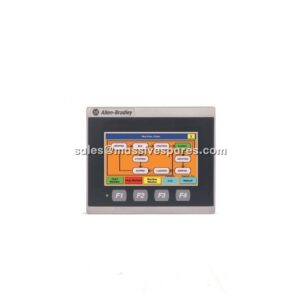
| Product Category | PanelView 1000 Standard operator terminal — grayscale touch screen HMI with integrated DH+ interface |
| Display Size | 10-inch class (10.4-in diagonal) grayscale active-matrix TFT; display area 211 × 158 mm (8.3 × 6.2 in) |
| Display Colour | 4 shades of gray — monochrome process mimic and text, no colour coding |
| Resolution | 640 × 480 pixels |
| Backlight | Cold cathode fluorescent (CCF), 100,000-hour rated life — replaceable, unlike modern LED-backlit panels |
| Touch Screen | Analog resistive, 384 touch cells arranged as 24 columns × 16 rows, touch cell size 26 × 30 pixels — works with gloves and stylus |
| Application Memory | 1008 KB non-volatile for application screens |
| RAM | 310 KB (256 KB ATA memory card supported for application transfer and backup) |
| Communication Port | Data Highway Plus (DH+) — 3-pin Phoenix connector labelled BLUE / CLEAR / SHIELD; node address set by two rotary switches, octal 00–77 |
| Printer / Transfer Port | RS-232 (DB-9, DTE) — alarm and event printing, and PanelBuilder32 application upload/download |
| Configuration Software | PanelBuilder32 — runs offline, with application testing and simulation before download |
| Input Power | 85–264 V AC, 47–63 Hz — wide-range AC input tolerating supply dips and international voltages |
| Heat Dissipation | 39 W (132 BTU/hr) |
| Enclosure Rating | NEMA Type 12/13 or 4X, front of panel — dust-tight and washdown-capable depending on bezel configuration |
| Operating Temperature | 0 °C to 55 °C (32–131 °F); storage −40 °C to 85 °C; 5–95 % RH non-condensing |
| Physical Dimensions | Approx. 282 × 370 × 112 mm (11.11 × 14.58 × 4.40 in) |
| Weight | Approx. 2.7 kg (6 lb) |
| Installation | Panel mount with six mounting clips; vertical mounting position |
| Compatible Controllers | PLC-5 and SLC 500 over DH+; ControlLogix and CompactLogix via DHRIO modules or partner adapters |
| Lifecycle Status | Discontinued / obsolete — supported through surplus, tested and professionally refurbished stock, plus component-level repair |
| Documentation | PanelView Standard Specifications 2711-TD007; User Manual 2711-UM014; Backlight Replacement 2711-IN020 |
| DC Variant | 2711-T10G8L1 — identical terminal with 24 V DC input for DC-powered panels |
Technical Principles and Innovative Values:
- Innovation Point 1 — DH+ as a first-class interface, not an afterthought: the “8” in the 2711-T10G8 marks an integrated DH+ module with an isolated transceiver and its own three-pin twinaxial connection. DH+ is Allen-Bradley’s proprietary token-passing protocol, and it is the reason this terminal can sit directly on a PLC-5 network with no gateway, no protocol converter and no middleware. A useful clarification for anyone planning a retrofit: DH+ is not RS-485. The DB-9 on the back of the 2711-T10G8 is a printer and transfer port behind a UART — controller traffic must always go through the DH+ Phoenix connector, and no converter on the serial port will change that.
- Innovation Point 2 — Grayscale chosen for legibility, not cost: a 640 × 480 monochrome TFT with four gray levels sounds like a compromise until you put it in front of an operator who has read the same mimic for fifteen years. The 2711-T10G8 renders process graphics, bar trends and alarm banners with high contrast and no colour ambiguity — no operator ever misread a status because a red and a green looked similar under plant lighting. On applications where colour carries no information, grayscale is not a downgrade; it is the display that matches the content.
- Innovation Point 3 — A 384-cell touch grid sized to the application: the 2711-T10G8 divides the screen into 24 columns × 16 rows of 26 × 30-pixel touch cells. That grid was engineered so a button drawn in PanelBuilder32 is comfortably larger than a gloved fingertip, which is why these panels survive in environments where a fine-pitch capacitive screen would be unreadable and unusable. The trade is deliberate: no gestures, no multi-touch — just large, unambiguous targets the operator can hit wearing gloves.
- Innovation Point 4 — Wide-range AC input that forgives the supply: 85–264 V AC at 47–63 Hz means the 2711-T10G8 is indifferent to whether it is fed from a 120 V North American panel, a 230 V European supply, or a plant network that sags under load. For multinational OEMs and for older plants with inconsistent distribution, that single specification removes the need for a voltage-selected variant or an external transformer.
- Innovation Point 5 — Offline development and memory-card transfer: PanelBuilder32 applications are developed, tested and simulated on a PC without the terminal present, then transferred to the 2711-T10G8 over the RS-232 port or stored on an ATA flash memory card (2711-NM13 2 MB through 2711-NM232 32 MB). Practically, that means an application change can be validated before anyone touches the running panel, and a known-good copy can live on a card in the cabinet — the cheapest and fastest recovery path when a terminal is swapped.
- Innovation Point 6 — A field-serviceable backlight: the CCF backlight in the 2711-T10G8 is rated at 100,000 hours and is replaceable, with documented access through the bezel and a specified screw torque. Modern panels integrate an LED backlight that cannot be replaced — when it dims, the whole terminal is scrap. On this one, a dim display is a maintenance item rather than a capital event, which is a large part of why so many of these units are still in service.