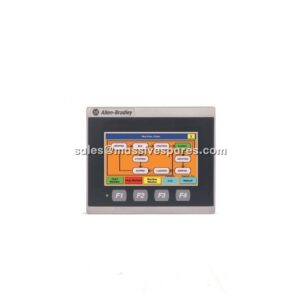

Description
Technical Specifications
| Parameter Name | Parameter Value |
|---|---|
| Product Model | Allen-Bradley 2711-T10C3 (Series A) |
| Manufacturer | Allen-Bradley (Rockwell Automation) |
| Product Type | Operator interface terminal, HMI graphic terminal |
| Series / Platform | PanelView Standard 1000 (Bulletin 2711), legacy PV1000 family |
| Display Size | 10 in class (10.1-10.4 in diagonal) |
| Display Type | Color active-matrix TFT with cold-cathode fluorescent (CCF) backlight |
| Display Area | 211 x 158 mm (8.3 x 6.2 in) |
| Display Resolution | 640 x 480 pixels (VGA) |
| Backlight Life | 50,000 h to half-brightness at 25 °C |
| Operator Input | Analog resistive touchscreen, 384 touch cells (24 columns x 16 rows), 26 x 30 pixel cell size |
| Application Memory | 1008 KB nonvolatile; 310 KB application runtime memory |
| Configuration Software | PanelBuilder32 |
| Control Network | DH-485 (RS-485 signaling), token-passing multi-drop, up to 32 nodes |
| Auxiliary Port | RS-232, printer output only (not usable for programming or runtime tag data) |
| Programming / Transfer Path | DH-485 port via 2711-NC13 cable or 1747-UIC USB-to-DH-485 converter |
| Compatible Controllers | SLC 500, MicroLogix, PLC-5 and other DH-485 devices |
| Input Voltage | 85-264 VAC, 47-63 Hz |
| Power Consumption | 55 VA maximum; heat dissipation 39 W (132 BTU/hr) |
| Real-Time Clock | Battery-backed, supports time-stamped critical data |
| Enclosure Rating | NEMA Type 12/13 or 4X (indoor use); IP65 front face |
| Operating Temperature | 0 °C to 55 °C (32 °F to 131 °F) |
| Storage Temperature | -25 °C to 70 °C |
| Panel Cutout | 257 x 338 mm (10.11 x 13.29 in) |
| Terminal Dimensions | 282 x 370 x 112 mm (11.11 x 14.58 x 4.40 in) |
| Mounting Depth | 97 mm; 129 mm with memory card retainer; 220 mm with card insertion clearance |
| Weight | Approx. 3.7 kg (8 lb) |
| Mounting Clearance | 51 mm (2 in) on all sides |
| Reference Documentation | Publication 2711-UM014, PanelView Standard Operator Terminals User Manual |
| Lifecycle Status | Discontinued / obsolete; supported through surplus and repair channels |
Main Features and Advantages
Purpose-built for legacy Allen-Bradley cells: The Allen-Bradley 2711-T10C3 speaks DH-485 natively, which is the network that late-1990s SLC 500 installations were built around. There is no gateway, no protocol converter and no OPC layer between the terminal and the processor, so tags resolve directly against SLC data files and the whole cell behaves exactly as it did on the day it was commissioned. For a plant with dozens of machines on the same architecture, that means one standard HMI, one programming tool and one spare part number rather than a migration project per machine.
Touchscreen designed for real operators: Rather than a fine-pitch capacitive surface, the Allen-Bradley 2711-T10C3 uses an analog resistive overlay divided into 384 discrete touch cells, each roughly 26 x 30 pixels. Buttons are therefore inherently finger-sized, the screen responds to gloves and styluses, and an operator working at speed is far less likely to miss a target than on a high-resolution panel with small active areas. Combined with a 640 x 480 color TFT at a size that reads clearly from normal working distance, the interface stays usable in the conditions a shop floor actually presents.
Straightforward power and panel integration: The 85-264 VAC, 47-63 Hz input range means the Allen-Bradley 2711-T10C3 can be installed on a standard machine AC feed anywhere in the world without a transformer or a selection jumper, and at 55 VA it places a modest load on the panel supply. A cutout of 257 x 338 mm and roughly 97 mm of mounted depth fit the enclosures these machines already have, and the NEMA 4X / IP65 front face holds up against dust, coolant and washdown when the terminal is clamped evenly against a flat panel.
Serviceable and repairable: Common failure modes on this platform are well understood — a worn touch overlay, a dim CCFL backlight, a failed inverter or a damaged communication port — and each is repairable at component level, which is usually far more economical than migrating a working machine to a new HMI platform. The Allen-Bradley 2711-T10C3 also retains its application in nonvolatile memory, so a replacement unit simply needs the PanelBuilder32 file transferred over DH-485 to return the panel to service.