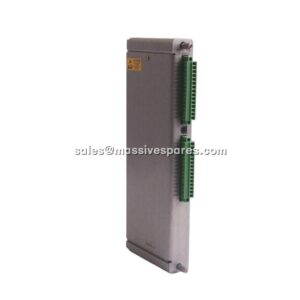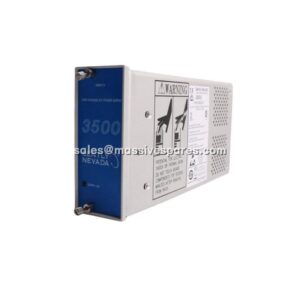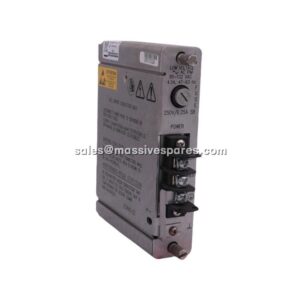

Description
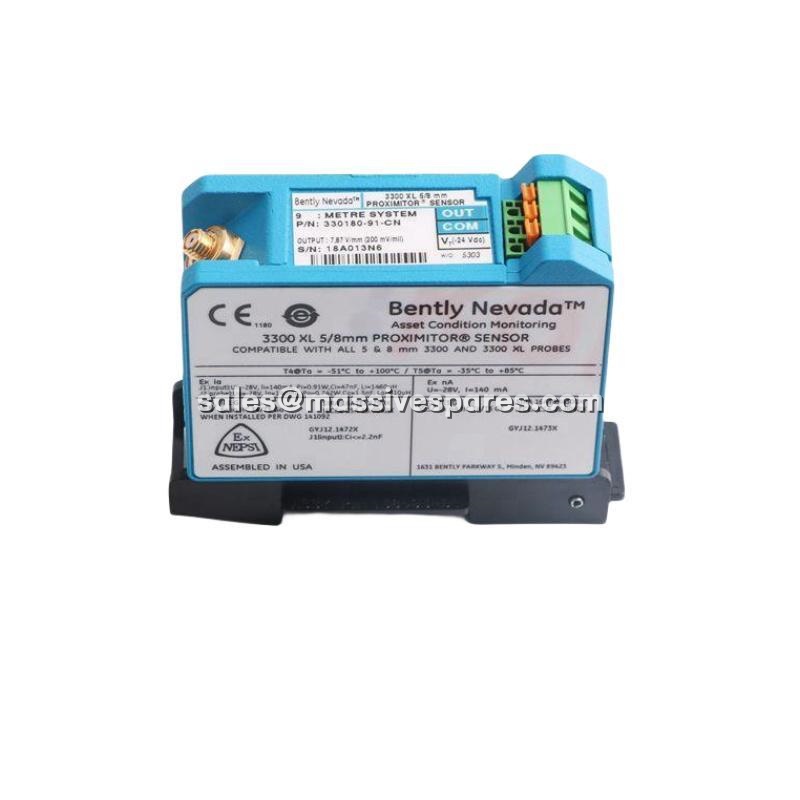
Technical Specifications
| Parameter Name | Parameter Value |
|---|---|
| Product Model | Bently Nevada 3300/50 (order format 3300/50-AXX-BXX-CXX-DXX) |
| Manufacturer | Bently Nevada (GE / Baker Hughes Bently Nevada) |
| Product Type | Tachometer monitor module, single channel |
| Series / Platform | Bently Nevada 3300 Series Machinery Protection System, API 670 |
| Functional Variants | -01 Dual Setpoint Tachometer; -02 Zero Speed Tachometer; -03 Rotor Acceleration Tachometer |
| Monitoring Channels | One; accepts two transducer inputs with internal voting logic |
| Compatible Transducers | 3300, 7200 and 3000 Series Proximitor probes; magnetic pickups |
| Input Frequency Range | DC to 10 kHz (auto threshold 10 Hz to 10 kHz) |
| Input Signal Level | 0.5 to 50 V peak-to-peak |
| Manual Threshold Range | User-selectable 0 to -18 Vdc |
| Hysteresis Range | User-selectable 0.2 to 2.0 V |
| Events per Revolution | Numerator 1 to 255; denominator 1 to 255 (ratio ≥ 0.1) |
| Shaft Speed Range | 1 to 99,999 RPM |
| Rotor Acceleration Range | -9,999 to +9,999 RPM/min |
| Zero Speed Threshold | Typically below 100 RPM |
| Speed Display Accuracy | Within ±1 RPM at +25 °C; display resolution ±1 RPM |
| Recorder Output | User-programmable +4 to +20 mA, 0 to -10 Vdc, or +1 to +5 Vdc |
| Output Compliance | 100 Ω voltage output impedance; 0 to +12 Vdc compliance across 0-600 Ω at 4-20 mA |
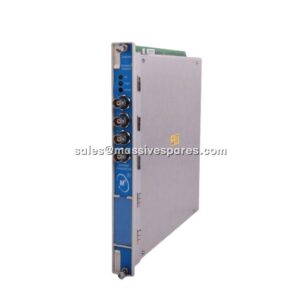
| Buffered Transducer Output | One coaxial BNC per transducer on the front panel, short-circuit protected, 100 Ω |
| Transducer Supply Voltage | -24 Vdc or -18 Vdc, user-programmable in the power supply |
| Alarm Setpoints | Digitally adjustable 0 to 100% full scale, stored in nonvolatile memory |
| Alert Relay Options | None, epoxy-sealed, or hermetically sealed |
| Full Scale Range Options | 100, 200, 500, 1000, 2000, 5000, 10000, 20000, 50000, 99999 RPM (shipped at 5000 RPM) |
| Front Panel Display | LCD, approx. 84 x 38 mm, speed and indication LEDs for OK, Alert, Danger, Bypass |
| Power Consumption | 2.5 W nominal from 3300 rack backplane |
| Operating Temperature | 0 °C to +65 °C; storage -40 °C to +85 °C |
| Relative Humidity | Up to 95% non-condensing |
| Dimensions (H x W x D) | 241.3 x 24.4 x 241.9 mm |
| Weight | Approx. 0.82 to 1.0 kg |
| Rack Position | One slot, any position except 1 and 2 |
Main Features and Advantages
Two transducers, one channel, fewer false indications: The Bently Nevada 3300/50 accepts two independent transducer inputs and resolves them with internal voting logic. On machines where a speed signal drives an alarm, a single failed probe or a severed cable would otherwise create a false low-speed or zero-speed condition and a spurious trip; voting removes that failure mode without doubling the number of monitors in the rack. Mixed input types are supported, so a proximity probe reading a keyphasor notch can be paired with a magnetic pickup for verification.
Measurement configured to the machine rather than to the module: With selectable full-scale ranges from 100 to 99,999 RPM, programmable events per revolution, a user-selectable threshold from 0 to -18 Vdc and adjustable hysteresis from 0.2 to 2.0 V, the Bently Nevada 3300/50 can be matched to a slow-turning gear or a high-speed turbine shaft rather than forcing the machine into a fixed instrument range. That configurability is what allows one part number to serve an entire plant’s speed-measurement needs, which directly reduces spare-parts variety.
Outputs that fit any control architecture: A user-programmable recorder output — +4 to +20 mA, 0 to -10 Vdc or +1 to +5 Vdc — feeds DCS, PLC and historian inputs for trending, while the front-panel BNC buffered outputs give vibration analysts a clean, short-circuit-protected copy of the raw transducer signal without breaking the loop. Alarm setpoints are digitally adjustable across 0 to 100% of full scale and held in nonvolatile memory, so configuration survives a power cycle.
Important application boundary: Bently Nevada states explicitly in the 3300/50 operation manual that its tachometers are not designed for use independently as, or as a component of, a speed control or overspeed protection system, because they do not provide the protective redundancy and response speed those functions require. The Bently Nevada 3300/50 is a monitoring and annunciation device; where a protective trip is required, a dedicated overspeed protection system such as the 3300/53 must be used.