
Description
Technical Specifications
| Parameter Name | Parameter Value |
|---|---|
| Product Model | 3500/33 (ordering format 3500/33-AA-BB) |
| Manufacturer | Bently Nevada (Baker Hughes) |
| Product Type | 16-Channel Relay Module / Relay Control Module |
| Series / Platform | Bently Nevada 3500 Machinery Protection System |
| Relay Outputs | 16 independent, individually programmable channels |
| Relay Type | Single-pole, double-throw (SPDT), Form C dry contacts |
| Relay Sealing | Epoxy-sealed for environmental protection |
| Arc Suppression | 250 Vrms arc suppressor installed as standard on every channel |
| Contact Life | 100,000 cycles at 5 A, 24 V DC or 240 V AC |
| Channel Grouping | Four groups of four channels, switch selectable for Normally De-energized (ND) or Normally Energized (NE) |
| Logic Capability | Per-channel Alarm Drive Logic with AND/OR combinations, voting, Normal/True options and latching by channel |
| Logic Inputs | Alert and danger statuses, Not-OK, and individual measured variables from any monitor channel or combination of channels in the rack |
| Configuration Software | 3500 Rack Configuration Software (version 3.3 or later); Data Acquisition 2.40+; Data Display 1.40+ |
| Contact Ratings, Standard DC | 5 A maximum, 70 W at 24 V DC, 10 W at 48 V DC, 9 W at 60 V DC, 125 V DC maximum |
| Contact Ratings, Standard AC | 5 A maximum, 1200 VA, 250 V AC maximum |
| Minimum Switched Load, Standard | 100 mA at 12 V DC |
| Low Current Option (A03/A04) | Gold-plated contacts, minimum load 1 mA at 1 V DC, maximum 100 mA at 48 V DC |
| Power Consumption | 5.8 W typical, supplied from the 3500 rack backplane |
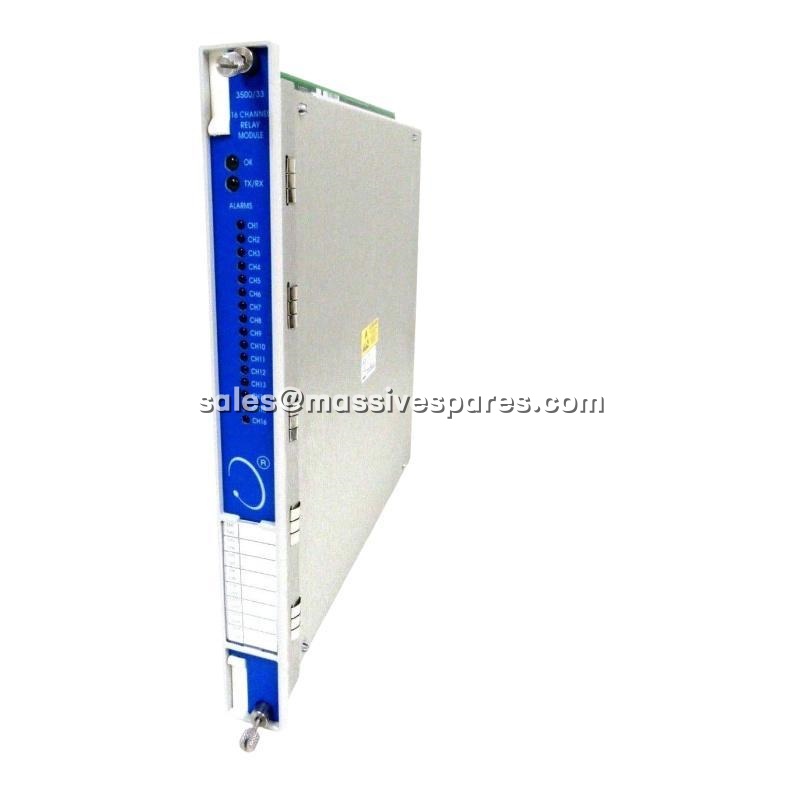
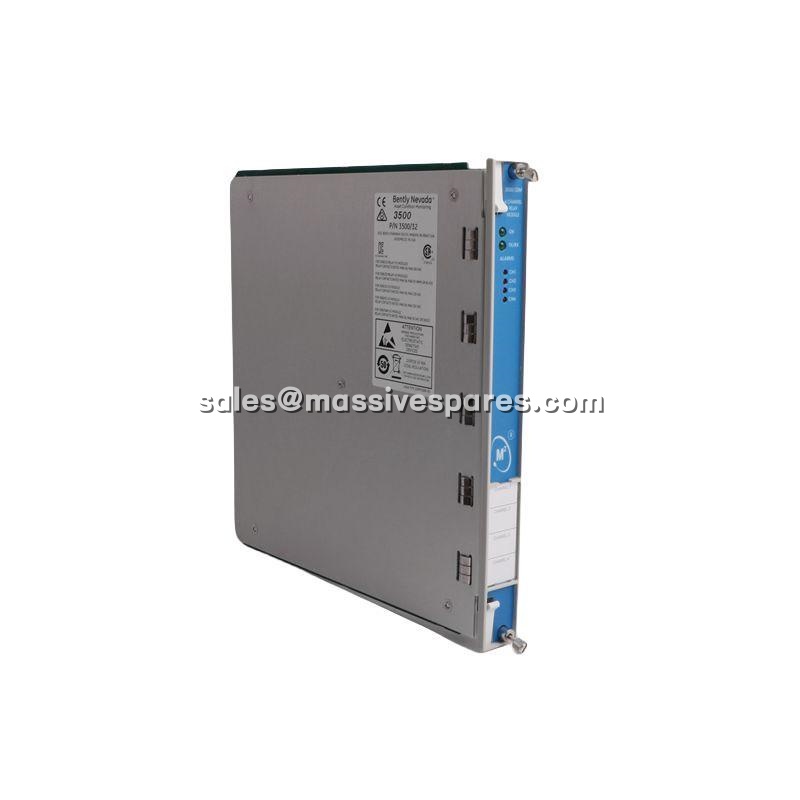
| Status Indication | OK LED, TX/RX LED, and one CH Alarm LED per channel |
| Rack Space | One full-height front slot for the main module, one full-height rear slot for the I/O module |
| Module Dimensions (H × W × D) | 241 mm × 24.4 mm × 242 mm (9.50 × 0.96 × 9.52 in) |
| I/O Module Dimensions | 241 mm × 24.4 mm × 99.1 mm (9.50 × 0.96 × 3.90 in) |
| Weight | Main module 0.7 kg; I/O module 0.4 kg |
| Operating Temperature | -30 °C to +65 °C (-22 °F to +150 °F) |
| Storage Temperature | -40 °C to +85 °C (-40 °F to +185 °F) |
| Humidity | Up to 95%, non-condensing |
| Hazardous Area Approvals | Available with cNRTLus Class I Div 2 or ATEX/IECEx/CSA Class I Zone 2 depending on ordering option |
| EMC / Safety | EN 50081-2 and EN 50082-2 EMC directives; EN 61010-1 safety; CE marked |
| Related Spares | 149986-01 Relay Control Module; 149992-01 Relay Output Module (also -02, -03, -04 variants) |
Main Features and Advantages
Per-channel Alarm Drive Logic replaces external voting hardware: The single most valuable capability of the 3500/33 is that every one of its sixteen outputs carries its own programmable Alarm Drive Logic, built from AND and OR combinations of alerts, dangers, Not-OK status and individual measured variables drawn from anywhere in the rack. This means complex shutdown philosophies — two-out-of-three voting on a compressor’s vibration channels, a trip requiring both high vibration and high bearing temperature, a permissive that must be satisfied before a start is allowed — are implemented in software inside the module rather than in rows of external relays, timers and wiring. The result is a smaller panel, a simpler drawing set, and a protection scheme that can be reviewed, revised and documented without a single wire being moved.
Sixteen independent channels with flexible operating modes: The 3500/33 provides sixteen fully independent SPDT outputs, so a single module can serve an entire machine train’s worth of alarm, trip, annunciator and interlock requirements. Because the channels are grouped into four banks of four, each switch-selectable for Normally De-energized or Normally Energized operation, the module can support both safety philosophies simultaneously: ND channels energise to trip, giving fail-safe behaviour on loss of power, while NE channels de-energise to trip and are commonly used for run permissives and health supervision. This flexibility lets protection engineers match the relay behaviour to the machine’s actual risk profile rather than compromising to fit the hardware.
Industrial-grade contacts with built-in protection: Every relay on the 3500/33 is epoxy-sealed, which protects the contacts from moisture, dust and corrosive atmospheres and is the reason these modules survive in refinery, offshore and chemical plant environments where unsealed relays fail prematurely. A 250 Vrms arc suppressor is installed as standard across each contact, limiting voltage spikes when switching inductive loads such as solenoid valves and motor contactors, which both extends contact life and prevents electrical noise from coupling back into the sensitive monitoring circuits in the same rack. With a contact life of 100,000 cycles at 5 A and ratings up to 5 A at 250 V AC, the outputs are capable of driving real field devices directly.
Diagnosability and maintainability: The 3500/33 front panel provides an OK LED for module health, a TX/RX LED that flashes to confirm communication with the rest of the rack, and a dedicated alarm LED for each of the sixteen channels, so a technician can see at a glance which relay is active and whether the module is healthy. Because the entire logic configuration lives in the 3500 Rack Configuration Software, the shutdown scheme can be reviewed and modified without physical intervention, and the module can be replaced with a like-configured spare without rewriting the logic. Combined with the 3500 platform’s hot-swap capability, this keeps maintenance windows short — an important consideration when the alternative is leaving a critical machine unprotected.