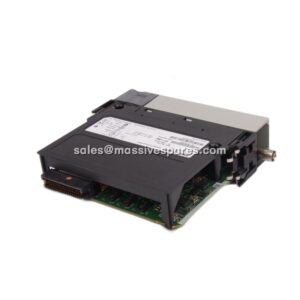
Description
Application Scenario
A cement plant in southern China was struggling with an aging relay-and-984-based control system on its raw-material yard and kiln feed line. The original controller had no redundancy, scan times were creeping up as the recipe logic grew, and the only communication path to the central SCADA room was a slow serial link that dropped data during thunderstorms. The engineering team needed a drop-in processor that could keep the existing Quantum I/O racks, cabling, and instrument loops intact while adding a redundant partner and a modern Ethernet uplink.
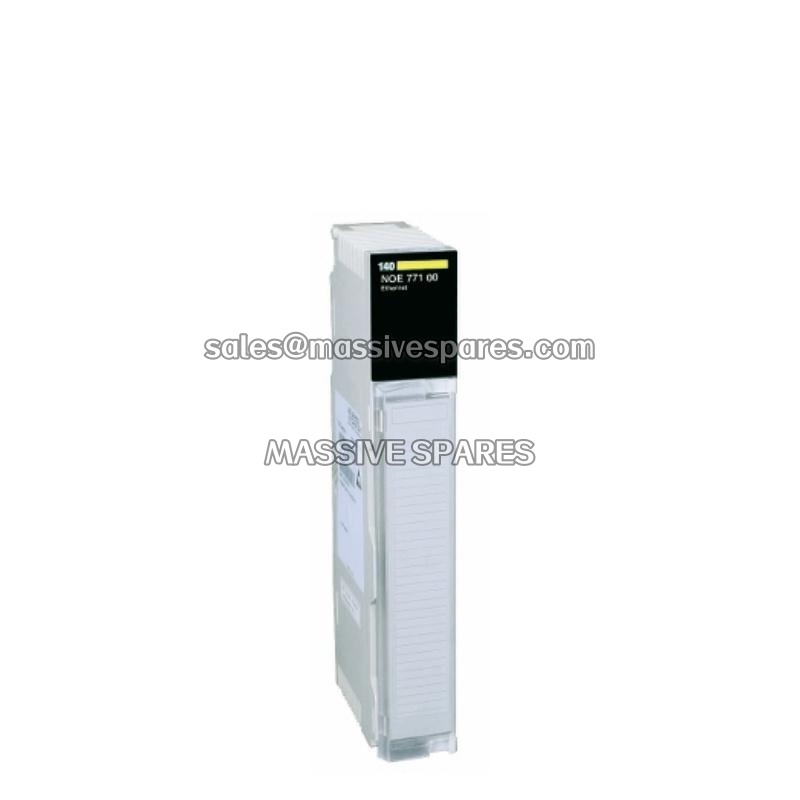
They chose the 140CPU53414A as the primary CPU, paired it with an identical “A”-revision unit for hot standby, and added a 140NOE77101 Ethernet module for the SCADA connection. Within a single planned maintenance window, the plant gained bumpless failover, a tenfold improvement in communication reliability, and enough free memory to consolidate the batch-recipe and alarm-history logic that had previously lived on a separate PC. Two years later, the control room reports zero process interruptions caused by the CPU, and the maintenance team carries a tested spare 140CPU53414A on site — a practice that has already paid for itself once during an unplanned battery failure.
Parameter
| Main Parameters | Value / Description |
|---|---|
| Product Model | 140CPU53414A (suffix “A” = hardware revision; Flash executive not cross-compatible with non-A) |
| Manufacturer | Schneider Electric (Modicon brand) |
| Product Category | PLC Central Processing Unit (CPU) / Processor Module |
| Processor | Intel 80586 DX, 133 MHz, with integrated math coprocessor — accelerates PID, flow totalization, and floating-point loops |
| Internal Memory | 2.7 MB (2,972 KB) SRAM, battery-backed — room for large ladder/FBD programs plus data tables |
| Option Module Interfaces | 6 slots for network/communication modules; up to 2 Modbus Plus modules with full Quantum DIO support |
| Communication Ports | 2 × Modbus RS-232 (programming / HMI / RTU-ASCII) + 1 × Modbus Plus RS-485 at 1 Mbps |
| Ethernet | Not native — add a 140NOE77101 or 140NOE77111 option module for TCP/IP |
| Hot Standby | Supported; up to 128 kB unlocated data synchronized each scan for bumpless failover |
| Watchdog Timer | 250 ms, software-adjustable — forces I/O to a safe state if the program freezes |
| Mode Security | Front-panel physical key switch (RUN / STOP / PROGRAM / MEM PRT) — prevents unauthorized or accidental changes |
| Memory Backup | 3 V lithium battery, 1,200 mAh, ~10-year shelf life; data retention through power loss |
| Power Draw | 5 V DC from Quantum backplane, approx. 1,250 mA (6.25 W typical dissipation) |
| Operating Temperature | 0 °C to +60 °C (32 °F to 140 °F) |
| Storage Temperature | -40 °C to +85 °C |
| Humidity / Altitude | 5 %–95 % non-condensing; up to 5,000 m above sea level |
| Dimensions (H × W × D) | Approx. 250 × 30 × 200 mm (single-slot Quantum module) |
| Weight | 0.91 kg (2.00 lbs) |
| Protection / Mounting | IP20, cabinet-mounted; plugs into dedicated CPU slot of a 140XBP backplane |
| Programming Software | Concept 2.6+ or ProWORX (native); upgradable to Unity Pro via OS-Loader (firmware PV04 minimum) |
| Languages | LD, FBD, SFC, ST, IL per IEC 61131-3 |
| Certifications | CE, UL 508, CSA C22.2 No. 142, FM Class I Div. 2 (revision-dependent) |
| Product Status | Discontinued by manufacturer — supplied as new-surplus, refurbished, or tested spare part |
Technical Principles and Innovative Values
Innovation Point 1: Hardware math coprocessor for real-time floating point. The 140CPU53414A pairs the 133 MHz 80586 core with a dedicated math coprocessor, so it handles thermodynamic equations, PID loops, and volumetric flow calculations natively in hardware rather than through software emulation. In practice this means shorter scan times on analog-heavy loops — the difference between a controller that keeps up with a fast compressor train and one that quietly falls behind.
Innovation Point 2: Three onboard communication ports, no gateway required. Two RS-232 Modbus ports and one 1 Mbps Modbus Plus (RS-485) port sit directly on the front faceplate. That lets the CPU talk to an HMI on one serial port, a third-party instrument or drive on the other, and run a deterministic token-passing network for distributed I/O and peer-to-peer messaging — all without buying a separate network interface card. The Modbus port can also auto-bridge into the Modbus Plus network when set to RTU or ASCII mode.
Innovation Point 3: Up to 128 kB of hot-standby synchronized data. Continuous-process plants cannot afford a hiccup during a controller switchover. The 140CPU53414A dedicates a memory pipeline to replicating working-register state to a secondary CPU every scan, so the standby takes over without disturbing live actuators. A critical detail buyers often miss: the two CPUs must carry the same suffix revision, so a “A” unit must be paired with another “A” unit.
Innovation Point 4: Physical key switch as a cybersecurity layer. Long before “cybersecurity” entered the automation vocabulary, this CPU used a mechanical key to gate transitions between RUN, STOP, PROGRAM, and memory-protect modes. For a validated process sequence, that is a genuinely useful barrier against both remote tampering and well-intentioned but uncertified local changes.
Innovation Point 5: Software-adjustable watchdog with a safe-state escape. Corrupted packets or a runaway subroutine can lock up a conventional controller and leave field devices frozen in their last state — dangerous around pumps, valves, and conveyors. The 140CPU53414A trips its 250 ms watchdog the moment the execution loop stalls, dropping the I/O rack into a predefined safe default.
Innovation Point 6: Six option-module interfaces for staged modernization. Need Profibus, fiber-optic Modbus Plus, Multi-Axis motion, or Ethernet today — and something else in five years? The six interfaces let the 140CPU53414A absorb new networks without replacing the CPU or rewiring the I/O backbone, which is why so many 1990s-installed Quantum racks are still operational.