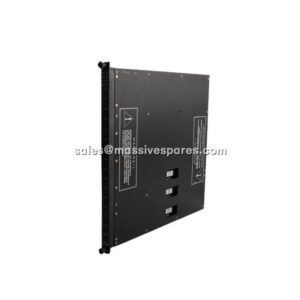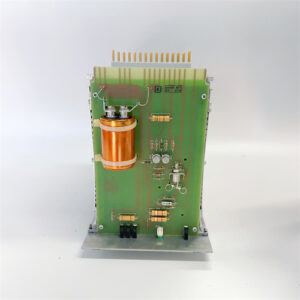

Description
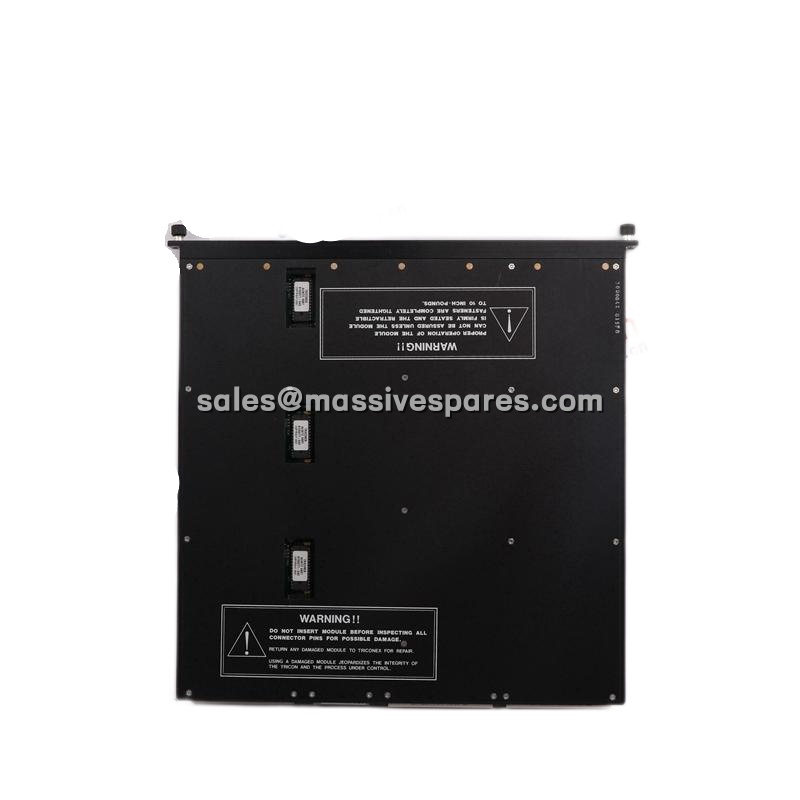
Application Scenarios
Picture a brownfield refinery modernising an ESD system that has grown organically for twenty years. The I/O list has ballooned past 1,800 discrete points, the control room cabinets are full, and nobody wants to pour a new slab to add a fourth panel. At the same time, the plant runs a mix of legacy 24 VDC loops and newer 48 VDC instrument power, and every spurious trip costs six figures in lost production.
This is the environment 3504E was designed for. Consolidating 64 points into one slot roughly halves the module count compared with 32-point alternatives, which releases slots for the expansion nobody thought was possible. Software-selectable 24/48 VDC means the same spare part covers both voltage families, so the storeroom carries one SKU instead of two. And because 3504E continuously verifies that its input circuitry can still transition between states, latent “stuck” failures surface as a maintenance work order rather than as a dangerous failure at the moment a real demand occurs.
The pain points it resolves are consistent across projects: cabinet space, spare-parts complexity, nuisance tripping, and the hidden cost of proof-testing hundreds of input channels by hand. In fire and gas systems, where dozens of detector contacts feed one voting matrix, the same logic applies — 3504E gives the safety logic a trustworthy, continuously validated picture of the field.
Parameter
| Main Parameters | Value/Description |
|---|---|
| Product Model | 3504E |
| Manufacturer | Invensys Triconex (Schneider Electric) |
| Product Category | High-Density TMR Digital Input Module |
| Input Points | 64, commoned, DC-coupled — groups of 8 simplify wiring and isolate diagnostic groups |
| Nominal Input Voltage | 24 VDC or 48 VDC, selected in TriStation 1131 software |
| Operating DC Range | 20–72 VDC (24 V mode: 20–36 VDC; 48 V mode: 40–72 VDC) — tolerates brownouts and mixed-voltage sites |
| Switching Levels | 24 V: OFF→ON ≥15 VDC typical, ON→OFF ≤8 VDC typical; 48 V: OFF→ON ≥27 VDC typical, ON→OFF ≤14 VDC typical — defines “clean” ON vs OFF |
| Switching Hysteresis | 4 VDC (24 V) / 7 VDC (48 V) typical — the noise margin that prevents chatter on long field runs |
| Input Delay | <10 ms for both OFF→ON and ON→OFF — fast enough for ESD and interlock logic |
| Input Impedance | >30 kΩ nominal, checked continuously — confirms the field circuit is intact, not just energised |
| Over-Range Protection | 115 VAC continuous / 150 VDC continuous — survives accidental cross-wiring to mains |
| Isolation | Optical isolation field-to-logic on each leg; no channel-to-channel isolation (by design, for density) |
| Diagnostics | Continuous stuck-ON and stuck-OFF testing; 1 ms diagnostic glitch every 2–3 s; per-point and PASS/FAULT/ACTIVE LEDs |
| Safety Certification | IEC 61508 SIL 3 (TÜV assessed), suitable for IEC 61511 safety instrumented functions |
| System Compatibility | Tricon v9, v10 and v11 main, expansion and RXM chassis |
| Installation Method | Keyed chassis slot, hot-spare supported; requires separate external termination panel (ETP) with cable interface to the Tricon backplane |
| Colour Code | Dark red faceplate — visual and mechanical keying against insertion into the wrong slot |
| Operating Temperature | 0 °C to 60 °C (32 °F to 140 °F) in a ventilated Tricon cabinet |
| Physical | Standard Tricon module format, approx. 2.1–2.7 kg; very low field-power loading (about 0.5 W per ON point at 24 V, negligible at 48 V) |
Technical Principles and Innovative Values
Innovation Point 1: Fully triplicated signal paths with hardware 2-out-of-3 voting. Every one of the 64 field signals on 3504E is fanned out to three independent legs (A, B and C), each with its own conditioning and optical isolation. A microprocessor on each leg scans the points, compiles a local input table, and the main processors vote the three tables before any logic executes. A single component failure is out-voted rather than becoming a trip — or worse, a missed trip.
Innovation Point 2: Active stuck-ON and stuck-OFF diagnostics. Most input cards are passive: they report what they see and fail silently. 3504E goes further by momentarily forcing a 1 ms diagnostic glitch every two to three seconds to prove the input circuit can still change state. This is what closes the “hidden failure” gap that plagues de-energise-to-trip logic, and it is a direct contributor to the diagnostic coverage needed for SIL 3.
Innovation Point 3: DC coupling instead of AC coupling. Because 3504E is DC-coupled, it reproduces the true state of a field contact without the decay distortion inherent in AC-coupled designs. Long-duration ON states read as ON, which matters when a permissive must remain latched for hours.
Innovation Point 4: One hardware platform, two voltage worlds. Selecting 24 V or 48 V in TriStation 1131 — not a jumper, not a different part number — lets 3504E standardise an I/O list across units that use different instrument power. The 20–72 VDC window absorbs supply sag and keeps reading correctly during a battery-backed transfer.
Innovation Point 5: Density as an economic lever. At 64 points per slot, 3504E roughly halves the slots, baseplates, ETPs and marshalling terminations required versus 32-point cards. In a 1,000-point system that typically translates into one fewer cabinet, one fewer set of system cables, and a materially shorter FAT and loop-checking schedule.
Innovation Point 6: Designed to survive human error. The dark red colour code and mechanical keying make it physically difficult to seat 3504E in an incompatible slot, while the 115 VAC continuous over-range rating means a mis-landed mains conductor damages neither the card nor the shutdown capability.
Application Cases and Industry Value
Case 1: Refinery ESD consolidation during a phased migration. A large fuel refinery running Tricon v10 needed to absorb roughly 1,400 discrete shutdown inputs — valve limit switches, pressure switch trips, local panel pushbuttons — into an existing cabinet lineup while keeping the unit online between turnarounds. The engineering team standardised new points on Triconex 3504E instead of the 32-point cards previously used. The 64-point density released enough slots to complete the migration without a new cabinet, and the software voltage selection allowed legacy 24 VDC and newer 48 VDC loops to share one bill of materials. During commissioning, the stuck-ON/stuck-OFF diagnostics flagged three channels whose field contacts had welded or whose wiring had degraded — faults that a conventional proof-test cycle would not have caught for another twelve months. Maintenance reported that fault localisation dropped from “swap the card and see” to a specific channel identified in TriStation, cutting mean time to repair from hours to minutes.
Case 2: Offshore platform fire and gas system. On a normally unmanned installation, the F&G system monitors dozens of flame, gas and manual call-point contacts across two modules. Triconex 3504E was selected because the 48 VDC instrument power standard did not match the 24 VDC cards already held in stock, and because hot-spare support allows a card to be replaced without shutting down the process or losing F&G coverage. The continuous diagnostics gave the operator documented evidence of channel health between proof tests, supporting an extended proof-test interval under the site’s IEC 61511 safety lifecycle — a direct reduction in offshore man-hours and helicopter trips. Feedback from the platform team centred on one point: the system no longer produces unexplained FAULT indications, because the module distinguishes a genuine channel fault from a module-level failure and keeps operating correctly in the presence of a single fault.