Q1: Why does my replacement DCS controller refuse to join the existing rack network?
A: The primary culprit is firmware desynchronization. Industrial automation controller modules feature non-volatile memory (EPROM, EEPROM, or Flash) holding base operating systems. If the replacement module’s firmware is newer or older than the rack’s primary controller or backplane bridge, communication protocols reject the node to prevent logic race conditions. You must verify and match both major and minor firmware revisions prior to hot-insertion.
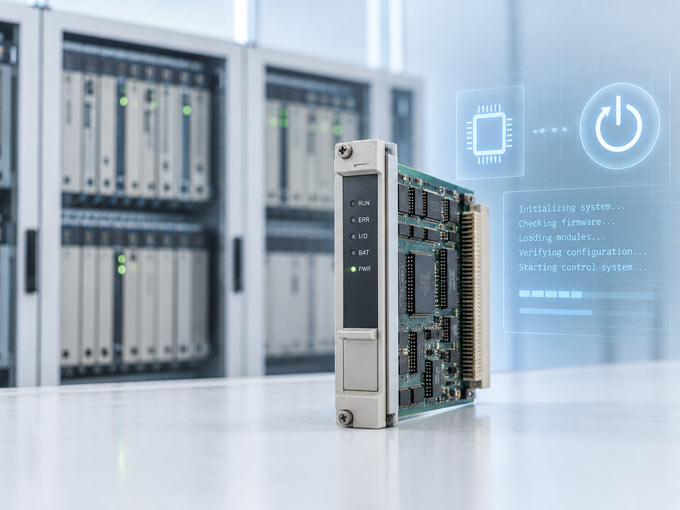
Firmware Compatibility and Cold Booting in Legacy DCS Racks
Q2: What is the correct protocol for cold booting a processor after battery depletion?
A: When onboard lithium coin cells drop below threshold, static RAM is wiped. Follow this sequence:
- Replace the battery with an OEM-specified industrial cell while the card is powered (if hot-swappable), or unpowered on an ESD bench.
- Insert the unit into the chassis and apply main rack power.
- Switch the run-key to MEM CLEAR or STOP according to platform guidelines.
- Establish a direct serial/Ethernet engineering connection and down-load the verified application program from your offline archive.
- Re-verify system real-time clock (RTC) variables before shifting the processor switch to RUN.
Q3: Can I swap an analog input card between different hardware revisions without modifying system configuration?
A: Not always. While many digital I/O modules maintain backwards compatibility, analog input cards (e.g., 4–20 mA, RTD, Thermocouple) often change internal A/D converter ICs across revisions. In platforms like Foxboro I/A Series (FBMs) or Bailey INFI 90, subtle revision changes alter terminal impedance, requiring distinct jumper placements or configuration updates in the engineering workstation software.
Q4: How should we address recurring “Watchdog Timer Timeout” error codes?
A: Watchdog failures point to processor task execution failure. Isolate the card from field I/O wiring. If the error persists in an empty test rack, internal crystal oscillators or voltage regulator caps have drifted out of operational spec, requiring professional hardware component repair.