
The Hidden Threat of Substandard Industrial Components
With the global scarcity of legacy silicon, counterfeiters have targeted industrial automation spares. High-value modules from Allen-Bradley (1756 series), Siemens (Simatic S7), and Schneider Electric often fall victim to re-marking, where lower-tier or broken components are cosmetically altered to mimic pristine parts.
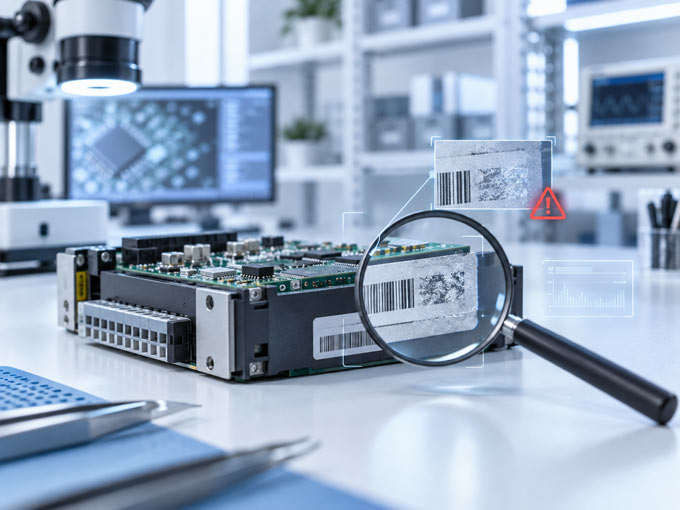
Forensic Checkpoints
1. Surface Topography & “Blacktopping”
- Acid Etching & Sanding: Fraudulent refurbishers sand down original part numbers, applying a thin epoxy layer known as “blacktopping” before laser-engraving higher-spec part numbers.
- Forensic Check: Wipe the IC package with acetone. Original OEM epoxy withstands solvent contact; blacktopping dissolves immediately, revealing microscopic sanding marks beneath.
2. Laser Marking Texture & Typography
- Edge Definition: Factory laser marking produces razor-sharp, uniform-depth lettering. Re-marked boards frequently display blurry font edges, improper kerning, or orientation inconsistencies.
- Manufacturer Logos: Counterfeiters frequently replicate logo geometry incorrectly. Verify font weight and trademark symbols against verified OEM reference samples.
+-------------------------------------------------------------+
| INSPECTION CALLOUT: PRINTED CIRCUIT BOARD (PCB) RE-WORK     |
+-------------------------------------------------------------+
| [!] Flux Staining      : Milky amber ring around IC leads   |
| [!] Solder Mask Touchup: Inconsistent green hue across traces |
| [!] Gold Finger Wear   : Scratches exposing underlying nickel|
+-------------------------------------------------------------+
3. Solder Joints & Connector Pins
- Look closely at pin solder balls and through-hole connections under 20x magnification. Hand-soldered joints exhibit dull finishes, flux splatters, and uneven wetting compared to factory wave soldering.
- Check edge card connectors (gold fingers). Factory new cards have an unblemished, mirror-finish hard gold plate. Scratched gold plating indicates the board was pulled from an active chassis.
4. Barcode Serialization Validation
Original OEM labels incorporate encrypted 2D DataMatrix or Code 128 barcodes matching human-readable serial numbers, hardware revisions, and plant manufacturing codes. Mismatched database lookups indicate fraudulent packaging.