Application Scenarios
The call always comes in the same tone. A chemicals plant has a 2003-vintage HC900 panel on a solvent recovery skid: four loops, all independent, all safety-adjacent but not safety-certified — column pressure, reboiler temperature, reflux ratio, and a hot-oil temperature. The DCS owns the long-term optimisation, but the skid must hold its own if the fibre link to the control room goes dark. The original control card died on a Tuesday, the OEM’s lead time quote came back measured in quarters, and the maintenance manager is being told to “migrate to a rack of new single-loop controllers” — which means new cutouts, new termination, new loop checks, and a change-control package nobody has budget for.
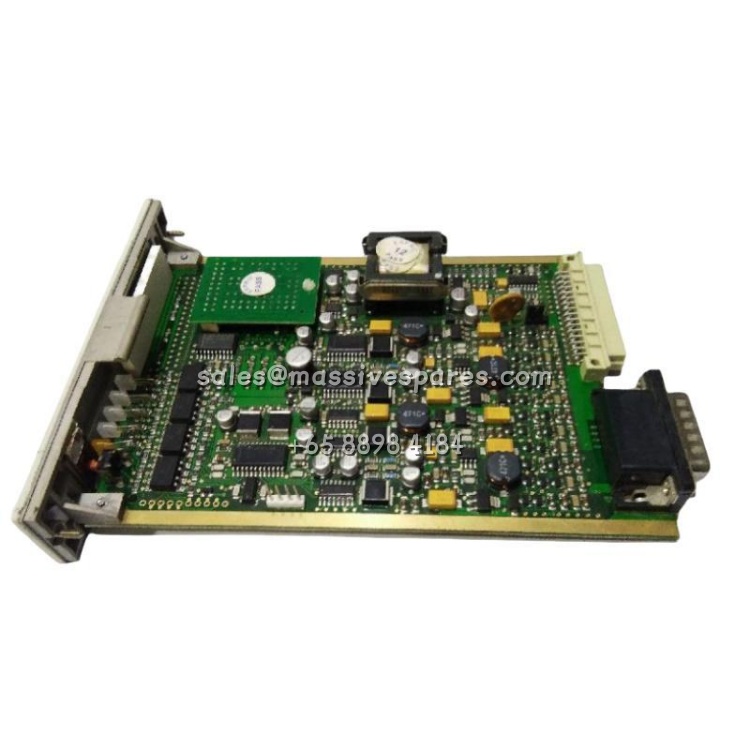
That is the insertion point for the 05704-A-0144. Same HC900 chassis, same terminal block and wire dress, same 24 VDC supply tap, same faceplate. Drop it in, load the archived configuration through the HC900 profiler tool, and the four loops come back on their old tuning. The DCS sees the same PV, SP and alarm points it always did. More importantly, the skid still controls itself for the forty minutes the link is down — because the loops were never running on the DCS to begin with. That architectural fact, not the part number, is what keeps the production manager off the phone.
Parameter
| Main Parameters | Value / Description |
|---|---|
| Product Model | 05704-A-0144 |
| Manufacturer | Honeywell Process Solutions, USA |
| Product Category | Four-channel hybrid control card (PID + sequencing), HC900 controller family |
| Platform | HC900 Hybrid Controller rack system; mates with 05704-A-0141/0142/0143 family cards, 05701-A-0502 CPU and 05704-A-0101/-0102 24 VDC supplies |
| Control channels | 4 fully independent loops, each with its own PID algorithm, output and alarm set — not time-sliced, not shared |
| Analog inputs | 4 × universal current/voltage inputs per channel group, software-configurable 4–20 mA / 0–20 mA / 0–10 V / 0–5 V / TC / RTD, 16-bit conversion typical |
| Analog outputs | 4 × 4–20 mA, galvanically isolated from input and from backplane, short-circuit protected, drive into 500 Ω+ |
| Discrete I/O | 8 dry-contact digital inputs (channel/function mapped), plus the card’s internal alarm and mode contacts surfaced to the rack image |
| Loop execution | 20 ms total module scan typical when all four channels are active with PID + alarm + math; individual loop update is deterministic and not dependent on DCS poll rate |
| Tuning | Autotune with adaptive/self-tuning variants in the HC900 algorithm set; manual bump-less transfer between auto, manual and cascade |
| Algorithms | PID, ratio/bias, cascade, feedforward, arithmetic, lead-lag, dead-time compensation, alarm latching, sequencing — all per-channel, all configured in the HC900 Profiler/Configuration tool |
| Communications | HC900 backplane to CPU; CPU exposes the rack to DCS via Modbus RTU/ASCII on the serial port or Modbus TCP / EtherNet-IP via the 900C controller head — the card itself is a backplane device, not an Ethernet endpoint |
| Isolation | 1 500 V AC channel-to-channel and channel-to-backplane typical; 24 VDC field supply is isolated from logic |
| Power | Drawn from the HC900 24 VDC backplane; keep the supply rail clean — a sagging 05704-A-0101 is the classic “loop drifts at noon” false fault |
| Operating temp | 0 °C to +60 °C, 5–95 % RH non-condensing; panel-mount, IP20, not for direct wash-down exposure |
| Dimensions | 1/4 DIN per channel module, rack-mount; face roughly 96 mm wide, depth behind the rail in the 120–140 mm class — confirm against your exact panel cutout before ordering |
| Mounting | HC900 DIN-rail / rack subassembly; seats behind the removable terminal block, retained by the card retainer |
| Diagnostics | Per-channel PV out-of-range, sensor break (burnout direction), output current limit, comms/watchdog status, module health — all visible on the CPU/display and exported to the DCS |
| Safety boundary | Not a SIL-rated device. Loops may be “safety-adjacent,” but the trip and shutdown path must be hard-wired or delegated to certified logic; never close the protective function through a PID output |
| Lifecycle | Mature/end-of-life within the HC900 family; practical supply is verified-surplus and test-bed qualified. Match the revision and the configuration file before a live swap |