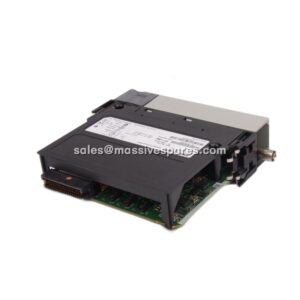
Description
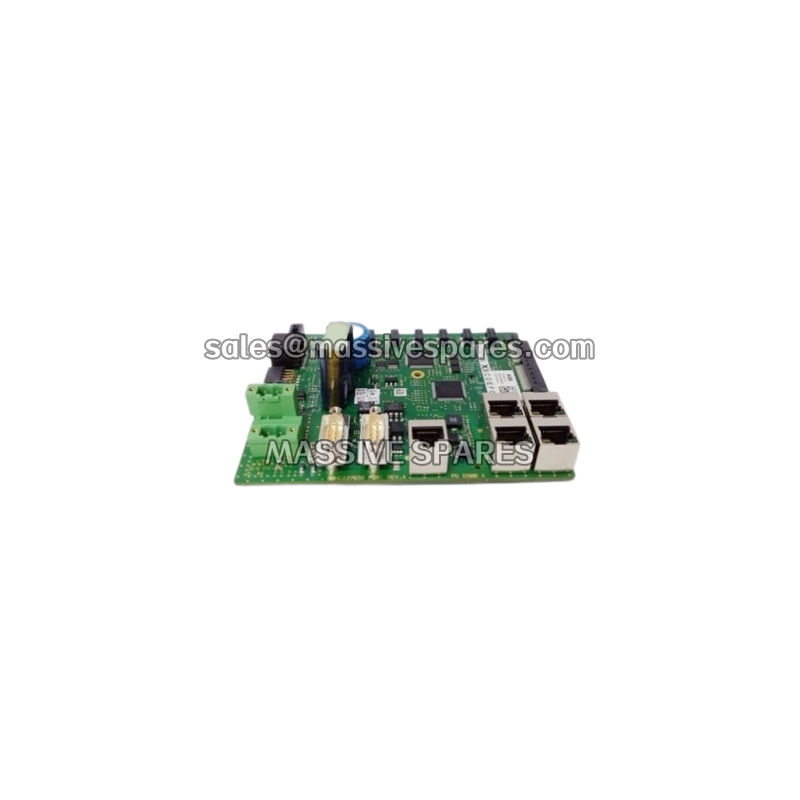
Technical Specifications
| Parameter Name | Parameter Value |
|---|---|
| Product Model | 3BHE037649R0101 |
| Commercial Designation | PD D500 A101 |
| Manufacturer | ABB (Hitachi Energy) |
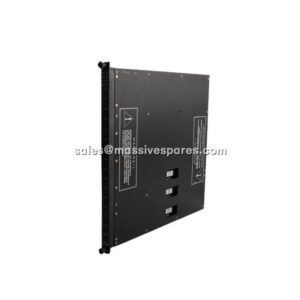
| Product Type | Digital Controller Module (Excitation Control Processor) |
| Series / Platform | UNITROL 5000 / UNITROL 6000 Static Excitation System |
| Processor | Digital Signal Processor, 300 MHz class |
| Co-Processor | FPGA (pulse generation, synchronization, blanking, interlocks) |
| Memory / Data Exchange | Dual-port RAM |
| Gate-Driver Outputs | 8 channels (configurable 6-pulse / 12-pulse bridge) |
| Firing-Angle Resolution | 0.2° electrical |
| Pulse Repetition Period | 360° (20 ms @ 50 Hz; 16.67 ms @ 60 Hz) |
| Regulation Task Cycle | 2 ms |
| Limit & Monitoring Task Cycle | 4 ms |
| Communication Task Cycle | 10 ms |
| Control Functions | AVR, PSS, VAr controller, limiter chain, start-up/shut-down sequence |
| Supply Voltage | 24 V DC |
| Supply Current | ≤ 5 A (fused terminal block) |
| Ethernet Interface | 100Base-TX, auto-negotiating, auto-crossover, front-panel RJ45 |
| Module Format | 3HU Eurocard (160 × 128.4 mm), depth 320 mm |
| Mounting | DIN rail, horizontal, in excitation control cubicle |
| Operating Temperature | 0 °C to +55 °C |
| Storage Temperature | -40 °C to +70 °C |
| Relative Humidity | 5 %–95 % RH, non-condensing |
| Pollution Degree | 2 (IEC 664) |
| Protection Rating | IP20 (indoor cabinet, IEC 60529) |
| Dielectric Test | 2.1 kV AC, 1 min (IEC 60255-5) |
| Galvanic Isolation | 500 V DC (controller to gate-driver outputs) |
| Typical Weight | Approx. 1.5 kg |
| Compliance | CE, IEC 60255, IEC 61000-6-2 / -6-4, UL 508 |
Main Features and Advantages
Deterministic real-time control architecture:
The defining strength of the ABB 3BHE037649R0101 is that it does not treat thyristor firing as a software timing problem. The DSP executes the AVR, PSS, VAr and limiter algorithms, while the FPGA owns pulse generation, bridge synchronization, pulse blanking and hardware interlocks. Because the FPGA operates in wall-clock hardware time, firing pulses are never delayed by a task switch or a communication interrupt. The measured firing-angle resolution of 0.2° electrical and a pulse repetition locked to the AC period (360°, i.e. 20 ms at 50 Hz or 16.67 ms at 60 Hz) give the excitation bridge exceptionally fine control over DC field voltage. For the plant, that resolves as tighter terminal-voltage regulation, less flicker on weak grids, and a generator that rides through disturbances instead of tripping on under-excitation or over-fluxing.
A complete excitation control strategy in one module:
The ABB 3BHE037649R0101 is not merely a pulse generator. It embeds the full control stack: automatic voltage regulator with terminal, reactive or compound feedback; power system stabilizer with configurable lead-lag and washout; VAr/power-factor controller for operation against a stiff grid; a limiter chain covering maximum excitation, minimum excitation (underexcitation/pole slipping), field overcurrent/overvoltage, stator current and U/f; and the complete start-up, synchronization, run and shut-down sequence logic. Having all of this resident in one module means there is a single failure boundary to manage and a single spare to stock. It also means the control behavior is coherent—the limiter and the regulator see the same process value at the same instant—which avoids the kind of interaction instability that appears when these functions are distributed across loosely coupled devices.
Eight configurable gate-driver channels:
The PD D500 A101 provides eight gate-driver outputs, software-configurable for a 6-pulse bridge, a 12-pulse bridge or a dual-bridge arrangement. This covers the overwhelming majority of salient-pole hydro generators, cylindrical-rotor thermal generators and synchronous compensators without custom hardware. Each output is galvanically isolated from the controller at 500 V DC, and the module monitors gate-driver health continuously. When a thyristor gate circuit fails, the diagnostic is reported immediately rather than discovered during the next voltage transient. The 5 A fused 24 V DC supply terminal is sized for the inrush of the gate-driver opto-drivers and includes a local fuse, so a shorted gate transformer stops at the terminal block instead of taking out the cubicle’s 24 V auxiliary supply.
Service access without process exposure:
The ABB 3BHE037649R0101 carries a front-panel 100Base-TX Ethernet port with auto-negotiation and auto-crossover, intended for the ABB service laptop and the excitation commissioning tools. This is a deliberately isolated service interface, not the plant network: it lets a technician read internal signals, tune PSS parameters, force a test pulse and extract event records without opening the cubicle or disturbing live field wiring. In a forced outage, that difference is measured in hours. The module’s 3HU Eurocard form factor (160 × 128.4 mm, 320 mm depth) and DIN-rail mounting mean it slides out and back in along the original rails—no drilling, no bracket fabrication, no cabinet modification.
Lifecycle continuity for legacy excitation:
For the large installed base of UNITROL 5000 systems, the ABB 3BHE037649R0101 is the current-production continuation part. It preserves the DIN-rail footprint, the 24 V DC fused supply, the eight gate-driver channels and the parameter set of the original design. A plant can therefore extend the life of a 15- to 25-year-old excitation cubicle without rewriting the AVR/PSS tuning, retraining the operators, or re-terminating the gate-fiber or field-feedback circuits. That is a materially lower-risk proposition than a full excitation-system replacement, and it is the reason this module commands the attention it does in spare-parts planning.