Description
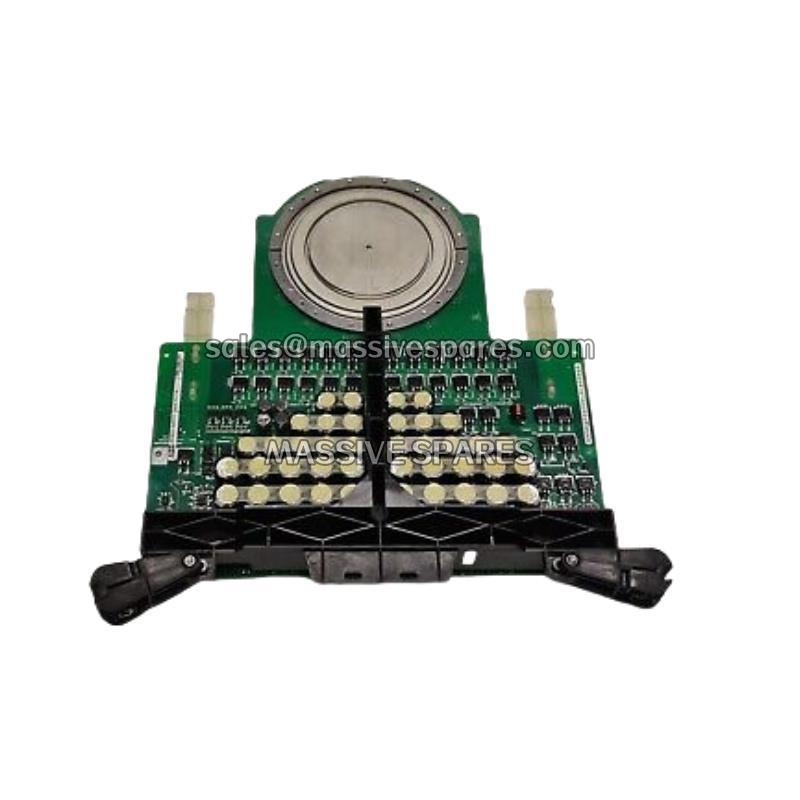
Technical Specifications
| Parameter | Value |
|---|---|
| Product Model | 5SHX2645L0004 |
| Ordering / Material No. | 3BHL000389P0104 (also 3BHB003154R0101, 5SXE03-0141) |
| Manufacturer | ABB Power Semiconductors (Hitachi Energy) |
| Product Type | RC-IGCT (Reverse-Conducting Integrated Gate-Commutated Thyristor) |
| Series | ABB 5SHX High-Power IGCT |
| Repetitive Peak Off-State Voltage VDRM | 4500 V |
| Average On-State Current IT(AV) | 2645 A (model-indexed; continuous ratings per thermal condition 1850–2800 A) |
| Repetitive Peak Turn-Off Current IGQM | ≥ 2600 A |
| Surge On-State Current ITSM (10 ms, 50 Hz) | 28–48 kA |
| On-State Voltage VTM at Rated Current | ≤ 2.1–3.5 V |
| Turn-Off Time tq | ≤ 2 µs (hard-driven gate) |
| dv/dt Tolerance | > 5000 V/µs |
| di/dt Tolerance | > 1000–2000 A/µs |
| Gate Trigger Current IGT | 150–200 mA |
| Gate Trigger Voltage VGT | 3.0–4.5 V |
| Gate Drive / Bias | +20 V / –20 V, fiber-optic isolated |
| Silicon Wafer Size | 91 mm (SPT buffer layer) |
| Thermal Resistance Rth(j-c) | 0.007–0.025 K/W (per revision and cooling face) |
| Cooling Method | Double-sided direct water cooling, deionized, 3–6 L/min per stack |
| Mounting | Ceramic press-pack, clamping force 25–40 kN |
| Operating Junction Temperature | –40 °C to +125 °C |
| Storage Temperature | –55 °C to +155 °C |
| Package | Ceramic-insulated press-pack disc |
| Weight | Approx. 2.6 kg |
| Failure Mode | Fail-short (short-circuit to ground reference) |
| Standards | IEC 60747-6; compliant configurations support IEC 61508 SIL 3 |
| Lifecycle Status | Discontinued by manufacturer; new-surplus and tested stock only |
Main Features and Advantages
Reverse-conducting integration that reshapes the power stack: The defining advantage of the ABB 5SHX2645L0004 is monolithic reverse conduction. By placing the freewheeling diode in the same press-pack as the IGCT, ABB eliminates the discrete antiparallel diode, the busbar that connects it, and the stray inductance that busbar introduces. In a three-level NPC phase leg this reduces the series device count from three to two and removes one thermal interface from the maintenance plan. The gain is visible in three places at once: lower switching loss because there is no snubber to absorb, lower conduction loss because there are fewer contacts in series, and higher reliability because there are fewer components to fail. For a drive engineer, “fewer parts in the current path” is the most valuable sentence in the specification.
Snubberless turn-off and dynamic avalanche ruggedness: Conventional GTO thyristors require a substantial RC snubber network to survive turn-off at voltage, and that network dissipates real power while occupying valuable cabinet volume. The ABB 5SHX2645L0004 extends the safe operating area to the dynamic avalanche boundary, so it can interrupt 2645 A at 4500 V without a dv/dt snubber. Compared with a conventional GTO solution, total switching plus snubber loss falls by 40–50 %. The SPT buffer layer also thins the silicon, which lowers both on-state and turn-off loss and permits operation in the low-kilohertz range—500 Hz is the typical ceiling in an ACS6000, though the device itself is capable of higher pulse rates when cooling permits.
Press-pack mechanics versus bonded modules: The ABB 5SHX2645L0004 makes no soldered joints and uses no aluminum bond wires. Electrical contact to both faces of the wafer is made by pressure, so thermal expansion is accommodated elastically rather than by fatigue of a solder joint. This is why IGCT press-packs survive millions of thermal cycles in applications—wind converters, marine propulsion, rolling-mill main drives—where the stack temperature swings with the production schedule. Double-sided cooling further flattens the thermal gradient across the wafer, keeping junction temperature below 125 °C even when the coolant enters at 40 °C. The specified clamping force is not a suggestion: under-clamping raises contact resistance and creates hot spots; over-clamping risks ceramic fracture. Both are irreversible, and both are common consequences of “just tighten it until it feels right.”
Fail-short behavior as a system safety feature: Unlike an IGBT module, which tends to fail open and leave a phase leg non-conductive, the ABB 5SHX2645L0004 fails short. In a series-connected valve or stack, a shorted device can be bypassed by the remaining devices (with appropriate derating), allowing the converter to degrade gracefully rather than collapse. This is the reason IGCTs remain the preferred device in HVDC valve halls and in safety-relevant STATCOM duties, and it is why spare strategy for the ABB 5SHX2645L0004 is properly a reliability calculation rather than a procurement afterthought: stock at least one per redundant leg, and track lot age against the 100,000-hour MTBF curve.
Low gate-drive burden with full isolation: Where a conventional GTO demands a gate turn-off peak current in the low-kilampere range, the ABB 5SHX2645L0004 is triggered by 150–200 mA at 3–4.5 V and turned off by a controlled current pulse from a local gate unit. The command travels as light down a fiber, so the control ground and the power ground need never meet. The result is a gate driver that is smaller, cheaper, and far less vulnerable to the EMI that a 5000 V/µs transient throws into the cabinet.