
Description
Application Scenarios
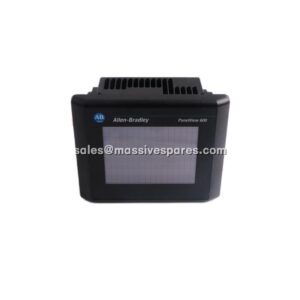
Walk into a 1990s-era water booster station and you will usually find the same picture: an SLC 5/04 on the backplane, a DH-485 trunk running out to the door, and a 2711-K5A8 showing wet-well level, pump status, alarm history and a three-button start/stop recipe. The screen is blue, the text is crisp, and the operator has never touched a mouse. One night the backlight flickers, the COMM LED goes dark, and the duty operator cannot tell which pump is locked out.
That is the moment the 2711-K5A8 earns its keep. Slide a tested surplus unit out of the stores cage, match the catalog suffix, drop it into the existing 192 × 138 mm cutout, land the AC line and ground, set the DH-485 node to the value written on the panel drawing (almost always node 2, with the SLC at node 1), reload the .PVA from the ATA card or a PanelBuilder32 transfer, and the screen comes back identical. No new cutout, no PLC tag rewrite, no validation paperwork, no operator retraining. The pump station’s alarm escalation path is intact before the next rain event.
Parameter
| Main Parameters | Value / Description |
|---|---|
| Product Model | 2711-K5A8 — PanelView Standard 550, keypad input, mono display |
| Manufacturer | Allen-Bradley, Rockwell Automation (USA) |
| Product Category | PanelView Standard graphic operator terminal (HMI) |
| Display | 5.5″ diagonal monochrome blue-mode STN LCD, transflective; 120 × 60 mm (4.75 × 2.38 in) viewable area |
| Resolution | 256 × 128 pixels — text, bar graphs, alarm banners and simple animations; no color, no grayscale wash |
| Operator input | Keypad only: 10 stainless-steel domed function keys (F1–F10) plus numeric and navigation cluster; no touchscreen |
| Communication | DH-485 (RS-485/RS-422 differential, RJ-45 media) plus an RS-232 printer/DF1 port; removable comms module on the rear determines the protocol family |
| Protocols / topology | DH-485 token-pass to SLC 500 (5/03, 5/04, 5/05), MicroLogix 1000/1100/1500 and PLC-5; DF1 point-to-point; 1200…19200 baud, 120 Ω termination at trunk ends |
| Input voltage | 85…264 V AC, 47…63 Hz (universal mains, NOT 24 V DC — the DC version is a different suffix) |
| Power & protection | ~15–20 W typical, 45 VA max inrush; 1.5 A 250 V slow-blow fuse; dedicated chassis ground under a star washer |
| Memory | 170 KB application runtime Flash; 240 KB nonvolatile object/text/bitmap store; battery-backed RTC for alarm timestamps |
| Expansion / backup | Type II ATA PCMCIA card slot — the original “USB stick”: holds the app, screens and event history for field reload |
| Enclosure & mounting | NEMA Type 12/13, 4X (indoor only), IEC IP54/IP65 front face; panel-mount via four clips, 1.1 N·m max |
| Dimensions | 197 H × 281 W mm bezel nominal (cutout 192 × 138 mm / 7.56 × 5.43 in); depth behind panel ~95 mm; ~1.2 kg (shipping weight commonly quoted 6 lb with packaging) |
| Environment | 0…+55 °C operating, −25…+70 °C storage, 5…95% RH non-condensing; 15 g operating vibration / 30 g non-operating shock; T2 surface-temperature code |
| Indicators & config | Green COMM LED, red FAULT LED; Configuration Mode via Left + Right arrow keys at boot; contrast and node set from the keypad |
| Software | PanelBuilder32 (legacy; original PanelBuilder 1400e files convert upward). Runtime is .PVA/.PVU; not a .MER PanelView Plus file |
| Lifecycle | Discontinued by Rockwell; current supply is surplus, refurbished or repair-channel stock — verify series letter and FRN before you buy |