
Description
Application Scenarios
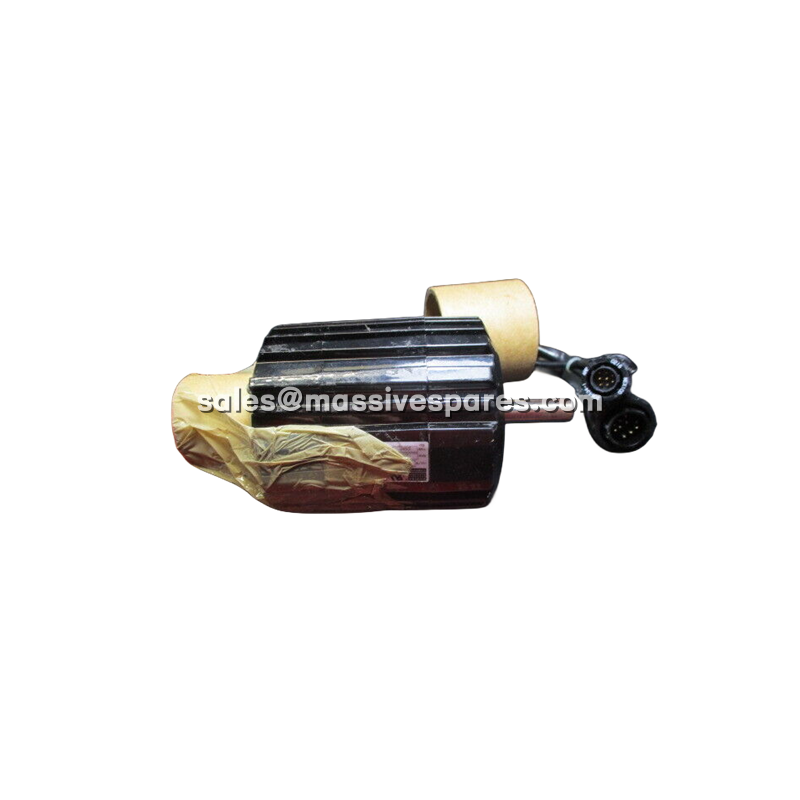
A precision rotary test station spins a machined rotor — holding it in a chuck, bringing it up to speed, and measuring runout and balance at a controlled RPM. The drive behind that chuck is a 3317HX, fed from a filtered DC speed control. What the application actually demands from the motor is not peak power; it is three things: a linear, predictable speed-torque curve so the control loop behaves the same at 200 rpm as it does at 2,000 rpm; smooth rotation at low speed, because a cogging motor puts its own vibration signature into a measurement that is supposed to be measuring vibration; and the ability to hold torque while the load changes as the workpiece is clamped and released.
That is exactly the duty Bodine builds its 130 VDC PMDC motors for, and it is why the 3317HX appears in spin chuck and turntable service rather than as a general-purpose fan motor. The skewed armature is what keeps low-speed rotation smooth, the oversized stabilised magnets are what keep the torque constant across the speed range, and the permanent-magnet field is what gives the near-linear speed-torque characteristic a DC speed control needs to regulate properly.
The practical pain point for the maintenance engineer is different. This is an OEM-configured motor on a machine that may be twenty years old, with no cross-reference in the current catalogue. When the 3317HX fails, the options look like a full drive redesign or a machine down indefinitely. In reality the replacement path is much shorter: match the voltage, the shaft, the mounting and the winding from the nameplate, and the existing DC control, chuck and mechanics all stay as they are.
Parameter
| Main Parameters | Value / Description |
|---|---|
| Product Model | 3317HX (Bodine Electric OEM-configured part number; the HX suffix identifies a specific winding, shaft and mounting build — confirm against the nameplate of the unit being replaced) |
| Manufacturer | Bodine Electric Company (USA) |
| Product Category | Permanent magnet DC (PMDC) servo-class motor, fractional horsepower, 130 V DC winding — configured for spin chuck / precision rotary duty |
| Rated Voltage | 130 V DC. This is Bodine’s standard industrial PMDC rail, distinct from the 90/180 V DC “SCR rated” windings and the 12/24 V DC low-voltage windings |
| Motor Type | Permanent magnet DC with a brushed commutator; reversible, adjustable speed, continuous duty, high starting torque with inherent self-braking |
| Speed-Torque Characteristic | Near-linear speed/torque performance — the property that lets a DC speed control regulate predictably across the whole speed range |
| Typical Rated Speed | 2,500 rpm nominal for Bodine’s 130 VDC PMDC motors of this frame class. Verify against the nameplate, since OEM-configured windings vary |
| Power Class | Fractional horsepower. Bodine 130 VDC motors in the 33-frame class span roughly 1/12 to 1/3 HP depending on winding. Verify the exact rating from the nameplate |
| Torque Behaviour | Constant torque across the adjustable speed range, with high starting torque — required for chuck clamping and for accelerating a heavy workpiece to speed |
| Enclosure | Totally enclosed, non-ventilated (TENV) construction. IP-40 typical for this Bodine motor class, with IP-44 and IP-20 variants across the family |
| Insulation System | Class F insulation materials with a Class B rating — headroom that allows the motor to run hot in a confined machine frame without shortening insulation life |
| Brush System | External brush access for inspection and replacement without disassembly; constant-force brush springs for long life and quiet operation; pre-seated graphite or copper-graphite brushes |
| Bearings | Noise-tested ball bearings, permanently lubricated; locked bearing arrangement that minimises shaft endplay — relevant wherever the motor feeds a measurement |
| Armature | Skewed armature design for smooth low-speed operation, reducing the cogging that would otherwise contaminate a vibration or runout measurement |
| Mounting | Face mount standard on Bodine’s 33-frame PMDC motors; L-bracket and foot-mount kits available. Confirm the mount on the HX build |
| Duty Cycle | Continuous duty operation; rated for adjustable-speed service with filtered or unfiltered DC controls |
| Control Compatibility | Designed for use with unfiltered SCR-type, or filtered and unfiltered PWM-type DC speed controls |
Technical Principles and Innovative Values
Innovation Point 1: Permanent magnet field, linear behaviour. A wound-field DC motor’s speed-torque curve bends as the field saturates; a permanent-magnet motor does not. The 3317HX uses oversized, stabilised magnets that resist demagnetisation and are matched to a common strength, which is what produces the near-linear speed/torque characteristic Bodine specifies. For a spin chuck driven from a DC speed control, that linearity is the whole point: the control’s gain behaves consistently at every speed, so the loop stays stable without retuning across the range.
Innovation Point 2: Skewed armature for measurement-grade smoothness. In a spin chuck or test station, the motor is upstream of a measurement. A conventional armature produces torque ripple at low speed, and that ripple shows up directly in a runout or balance reading as if it were a property of the workpiece. The skewed armature in the 3317HX smooths low-speed rotation at the source, so what the instrument measures is the part, not the motor.
Innovation Point 3: 130 V DC chosen for constant-torque industrial duty. Bodine offers 12/24 V DC for battery and solar equipment, 90/180 V DC as “SCR rated” windings, and 130 V DC as the industrial standard. The 3317HX sits on the 130 V rail because that is the winding intended for adjustable-speed, constant-torque work — the motor delivers its rated torque whether it is turning slowly under load or running up to speed, which is what a chuck that clamps, accelerates and indexes actually requires.
Innovation Point 4: Serviceable brushes instead of a sealed life. Sealed motors are cheaper to buy and impossible to repair. Bodine’s PMDC design gives external brush access, constant-force springs and pre-seated brushes, so brush inspection and replacement happen at the machine without a strip-down. On a production asset, the 3317HX is a maintainable component rather than a consumable one, and brush wear is a scheduled item rather than an unplanned failure.
Innovation Point 5: Bearings specified by noise class. Every Bodine PMDC motor in this family uses noise-tested, permanently lubricated ball bearings with a locked bearing to minimise endplay. That combination is not marketing language — it is what keeps shaft runout low over years of service, which matters both for the chuck’s own accuracy and for the acoustic environment of a laboratory or inspection cell.
Innovation Point 6: Self-braking and high starting torque as built-in safety. Permanent magnet DC motors provide significant starting torque and inherent self-braking when power is removed. On a spin chuck, that means the drive accelerates a clamped workpiece decisively and comes to rest predictably rather than coasting, which is both a cycle-time benefit and a guarding benefit.