
Description
Technical Specifications
| Parameter Name | Parameter Value |
|---|---|
| Product Model | IS220PHRAH1A |
| Manufacturer | General Electric (GE Energy) |
| Product Type | HART-Enabled Analog I/O Pack (PHRA) |
| Product Series | GE Mark VIe Speedtronic |
| Analog Inputs | 10 channels (inputs 1–8: 4–20 mA or ±5 V; inputs 9–10: 4-20 mA or ±1 mA) |
| Analog Outputs | 2 channels (4–20 mA / 0–20 mA current loops) |
| Total Channels | 12 |
| Input Resolution | 16-bit A/D converter |
| Output Resolution | 14-bit D/A converter |
| Output Accuracy | 0.5 % |
| Output Load Capability | 800 Ω (for 0–20 mA output) |
| Measurement Accuracy | Better than 0.1 % full scale over −30 °C to +65 °C; typical 0.007 % FS at 25 °C |
| Normal Scan Time | 5 ms (200 Hz) |
| Input Filtering | Two-pole hardware filter at 12.5 Hz and 48.3 Hz; configurable software low-pass filter (0, 0.75, 1.5, 3, 6, 12 Hz) |
| Common-Mode Rejection | 60 dB at 60 Hz (AC); 80 dB (DC); common-mode voltage range ±5 V |
| HART Support | HART message relay in 4–20 mA mode; any input or output channel may connect to a HART device |
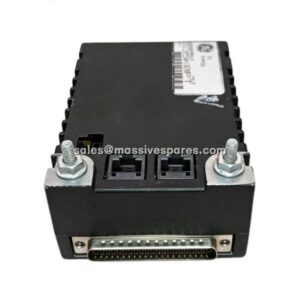
| Communication Interface | 2 × RJ45 10/100 Mbps Ethernet (IONet); local serial communication via IR port |
| Power Supply | 28 VDC nominal (from terminal board / system power) |
| Power Input Connector | 3-pin connector on side of pack |
| Terminal Board Interface | DC-62 pin connector |
| Terminal Board Compatibility | IS200SHRAH1A, IS200SHRAH2A |
| Configuration | Simplex only |
| Operating Temperature | −30 °C to +65 °C |
| Storage Temperature | −40 °C to +85 °C |
| Humidity | 5 % to 95 % RH, non-condensing |
| Dimensions | 8.26 cm × 4.19 cm × 12.1 cm (82.6 mm × 41.9 mm × 121 mm) |
| Hazardous Area Approval | Class I, Zone 2; Ex nC [ic] IIC T4 |
| PCB Protection | Conformal coating |
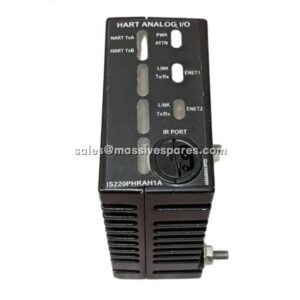
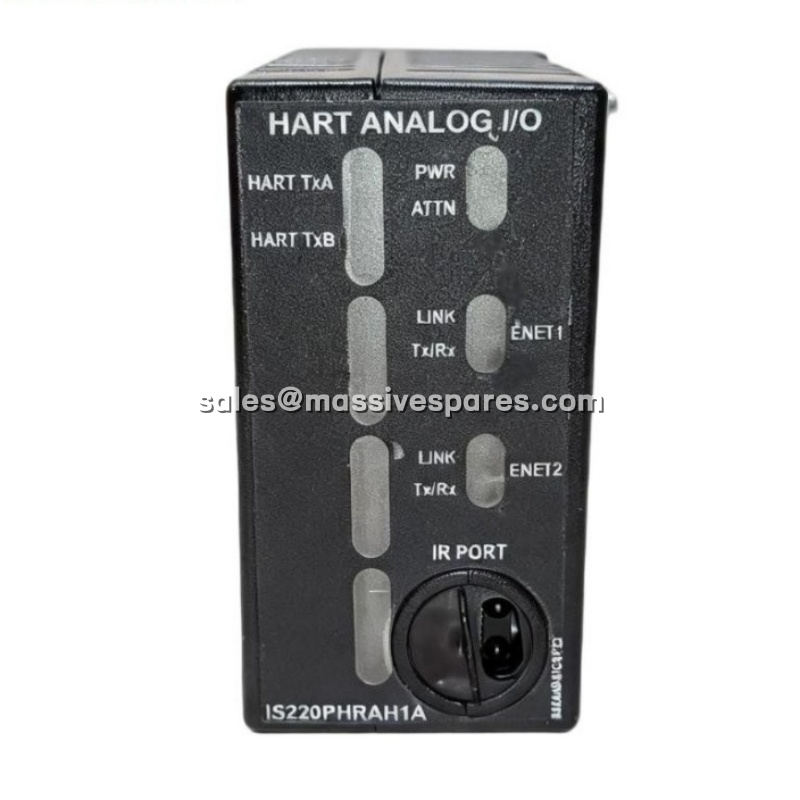
| Status Indicators | LEDs: HART TxA, HART TxB, PWR, ATTN, LINK, TX/RX (ENET1, ENET2) |
Main Features and Advantages
Native HART pass-through over 4–20 mA loops
The GE IS220PHRAH1A is built around HART transparency rather than HART as an add-on. When configured for 4–20 mA operation, it relays HART communication between connected field instruments and an asset management system. Because either an input or an output channel can host a HART device, a single pack can serve both measuring transmitters and HART positioners without dedicating separate communication hardware to each loop. The two yellow HART TxA and HART TxB LEDs confirm on-pack when a HART message is being sent to a field device, giving maintenance staff immediate visual evidence that digital traffic is active.
High-resolution conversion for turbine-grade analog accuracy
Inputs use a 16-bit A/D converter, and outputs a 14-bit D/A converter. The stated measurement accuracy is better than 0.1 % of full scale across the entire operating temperature range, with a typical figure of 0.007 % FS at 25 °C. This level of precision matters directly to turbine control: fuel-flow and temperature transmitters, valve-position feedback, and pressure signals all feed control loops where small errors affect efficiency, emissions, and equipment life. The 5 ms normal scan time and 200 Hz effective rate provide the update cadence expected by Mark VIe control frames running at 100 Hz.
Two-stage analog filtering and strong common-mode rejection
Each of the ten input circuits is protected by a two-pole hardware low-pass filter at 12.5 Hz and 48.3 Hz, followed by a configurable two-pole software low-pass filter offering cut-off choices from 0 to 12 Hz. This combination removes high-frequency noise from VFDs, contactors, and generator exciters while retaining the dynamics needed for process signals. Common-mode rejection is specified at 60 dB at 60 Hz on AC and 80 dB on DC, with a ±5 V common-mode voltage range. The result is stable analog data in the electrically harsh environment of a turbine control cabinet.
Termination-resistor sensing preserves loop integrity
For current-loop inputs, the load-termination resistors are mounted on the terminal board rather than inside the pack. The GE IS220PHRAH1A detects the voltage developed across those resistors to determine loop current. This arrangement keeps high-current loop power and burden resistors in the termination hardware while the sensitive measurement and HART electronics remain on the pack, improving both safety and serviceability.
Dual Ethernet with redundant IONet architecture
Two fully independent 10/100 Mbps RJ45 Ethernet ports connect the pack to one or two I/O networks. Either port will support operation on its own, while a dual connection provides network redundancy. In typical Mark VIe practice, ENET1 is connected to the network associated with the R controller. Redundant Ethernet, combined with comprehensive on-pack diagnostics, reduces the risk that a single network fault will isolate analog data from the controller.