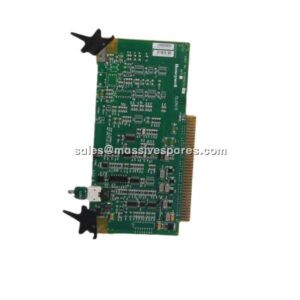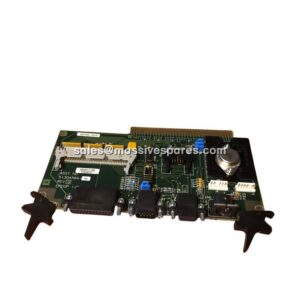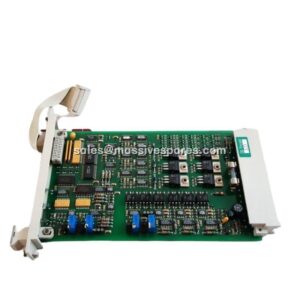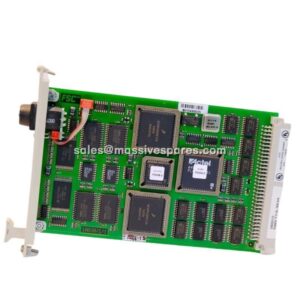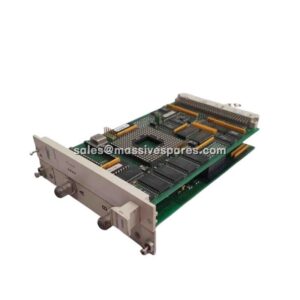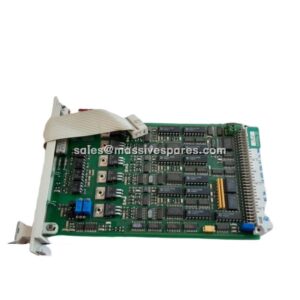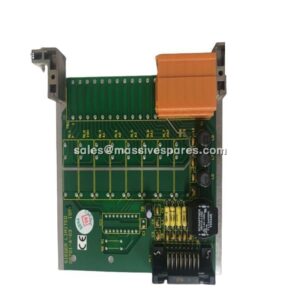

Description
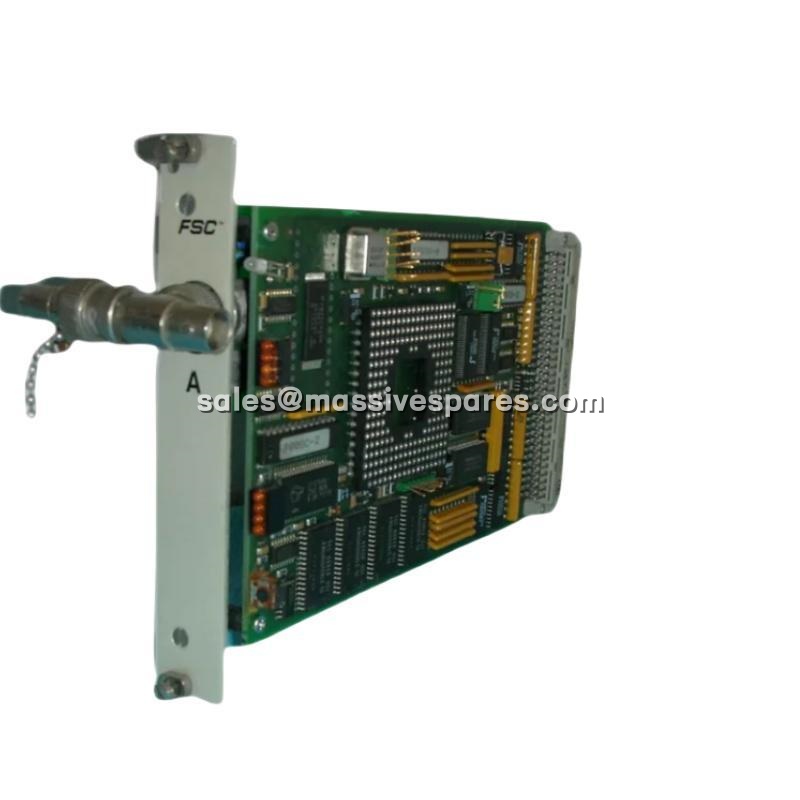
Technical Specifications
| Parameter Name | Parameter Value |
|---|---|
| Product Model | 10024/I/F |
| Manufacturer | Honeywell |
| Product Type | Enhanced Communication Module (ECM) / FSC serial communication card |
| System Family | Honeywell Fail Safe Controller (FSC) |
| Type Number | 27100 |
| I-Interface (Port A) | Isolated RS-485 / RS-422, 9-pin male connector |
| F-Interface (Port B) | Tri-state RS-232C, 9-pin female connector |
| I-Interface Max Baud Rate | Up to 2 Mbaud |
| F-Interface Max Baud Rate | Up to 38.4 kbaud |
| Galvanic Isolation | Greater than 6 kV on both interfaces |
| I-Interface Cable Length | 1.2 km at ≤100 kbaud; 1 km at 125 kbaud; 120 m at 1 Mbaud; 60 m at 2 Mbaud |
| F-Interface Cable Length | 15 m at ≤19.2 kbaud |
| Supported Protocols | FSC-FSC, FSC-DS, Modbus RTU, Modbus H&B, RKE3964R, SER (Sequence of Events Recording) |
| Power Supply | 5 Vdc from FSC rack backplane, 650 mA |
| Rack Space Requirement | 8 TE (8 HP) horizontal × 3 HE (3U) vertical |
| Max I-Interfaces per System | 16 |
| Modules per Central Part | Up to 4 communication modules (8 links) |
| Diagnostics | TxA, RxA, TxB, RxB front-panel LEDs; internal watchdog on each port |
| Configuration | J1/J2 jumpers set COM module address; J3 program source; J4/J5 EPROM type |
| Software Requirement | FSC system software ≥ 2.78f, configuration software ≥ 530 |
| Approvals | CE, UL, TÜV |
| Operating Temperature | 0 °C to +60 °C |
| Storage Temperature | −40 °C to +85 °C |
| Approximate Dimensions | 203 mm × 152 mm × 51 mm |
| Weight | Approximately 0.3 kg |
Main Features and Advantages
Dual-interface design on one card: The Honeywell 10024/I/F carries two electrically different serial ports in a single slot, which is exactly what a safety node usually needs. The I-interface handles multi-drop RS-485/422 runs out to remote equipment, analysers, or third-party controllers, tolerating cable lengths of more than a kilometre at low baud rates and 60 metres at the full 2 Mbaud. The F-interface provides a short, point-to-point tri-state RS-232C link for local engineering stations, modems, or printers. Because both are installed together, one slot satisfies two requirements and leaves the remaining COM positions free for other peers.
Isolation that protects the safety bus: Both ports on the Honeywell 10024/I/F are isolated beyond 6 kV. In practice this means a ground potential difference across a plant, a lightning-induced surge on a long cable run, or a miswired third-party device cannot inject destructive energy into the FSC backplane. For a system whose entire purpose is to remain available and correct during abnormal conditions, that isolation barrier is not a convenience — it is part of the safety argument.
Offloaded communications preserve deterministic behaviour: The Honeywell 10024/I/F contains its own communication processor and flash memory, so protocol handling, buffering and sequence-of-events recording happen locally. Heavy Modbus polling from a DCS or a burst of SOE data during a plant upset does not consume central processor time, and the safety logic scan remains deterministic regardless of what is happening on the wire.
Straightforward diagnostics and addressing: Four front-panel LEDs — TxA, RxA, TxB, RxB — show transmit and receive activity on each port, so a technician can identify a one-way link, a dead peer, or a reversed pair at a glance without a protocol analyser. COM position is set through J1/J2 jumpers in binary fashion, letting up to four modules coexist in one Central Part, and the module retains its configuration so a like-for-like replacement does not require a full re-engineering exercise.
Built for the SIL 3 environment it serves: The Honeywell 10024/I/F is approved to CE, UL and TÜV and is designed for continuous duty in the controlled environment of a safety system cabinet, where watchdog supervision on each port ensures that a hung channel is detected rather than silently tolerated.