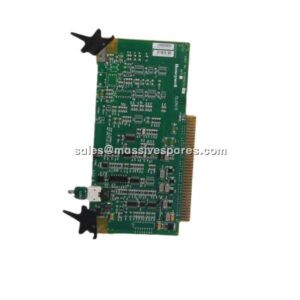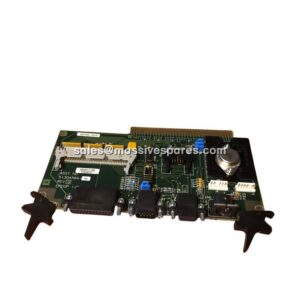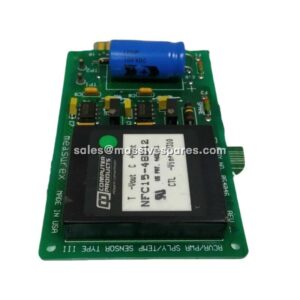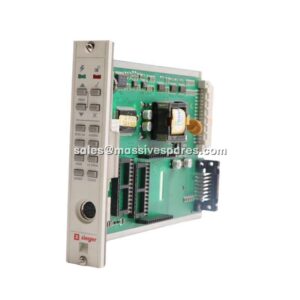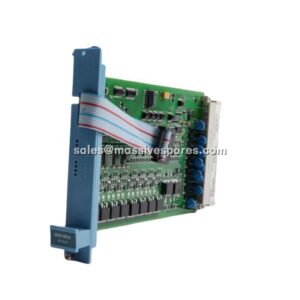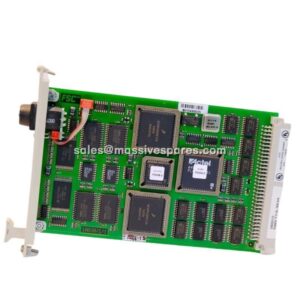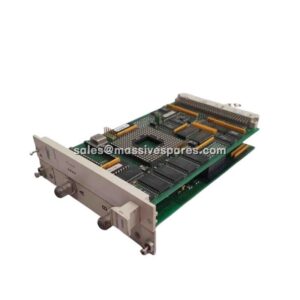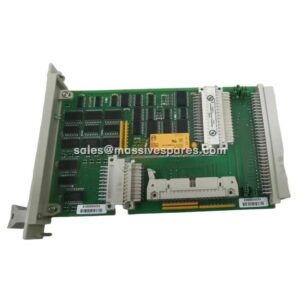

Description
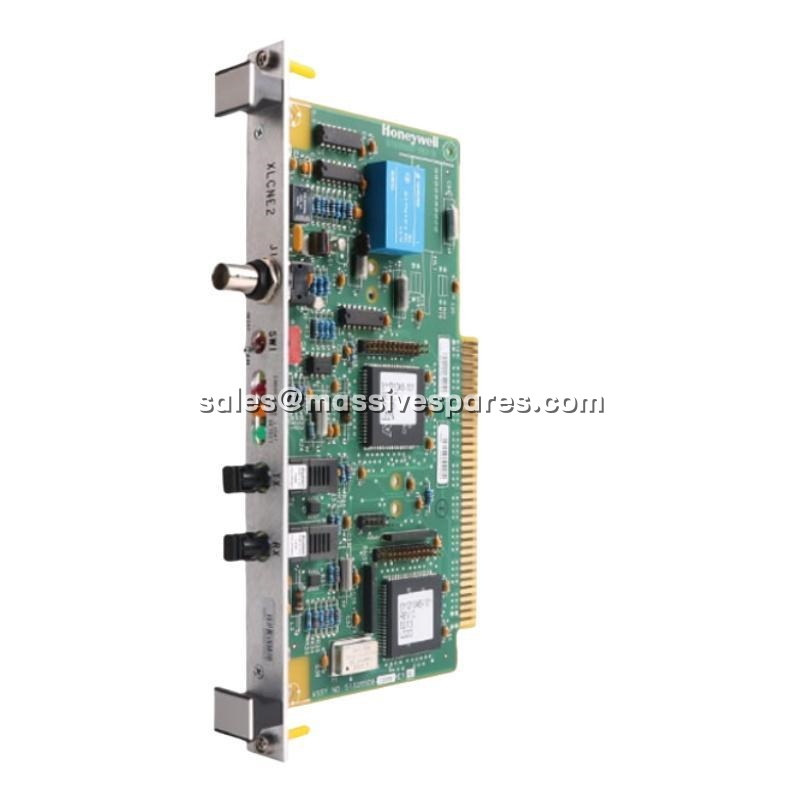
Technical Specifications
| Parameter Name | Parameter Value |
|---|---|
| Product Model | Honeywell 51305508-200 (XLCNE2) |
| Manufacturer | Honeywell |
| Product Type | LCN Extender Paddle Board |
| System Platform | Honeywell TDC 3000 / Experion PKS |
| Network Extended | Local Control Network (LCN) |
| Transmission Medium | Multimode optical fiber |
| Connector Type | ST-type fiber optic connectors |
| Redundancy Support | Dual-cable (A & B) architecture |
| Typical Deployment | 4 boards per full LCN extension (A & B at each end) |
| Board Construction | Passive PCB — no active electronic load |
| Power Consumption | Negligible (passive board; system-supplied backplane power only) |
| Compliance / Certification | CE certified (TUV / UL508 / CSA on select revisions) |
| Dimensions (approx.) | 2.0 cm × 13.5 cm × 23.7 cm |
| Weight (approx.) | 0.2 kg (≈ 0.44 lb) |
| Operating Temperature | 0 °C to +60 °C (standard industrial ambient; confirm per revision) |
| Storage Temperature | −40 °C to +85 °C |
| Humidity Tolerance | 5 % to 95 % RH, non-condensing |
| Country of Origin | United States |
Note: The XLCNE2 is a passive interface/paddle board — it contains no processor, memory, protocol engine, or power electronics. Claims of “RS-485 / Modbus / Ethernet/IP,” EEPROM capacity, or ampere-level I/O ratings found in some third-party listings are inaccurate for this model and do not apply. Always verify the unit label and the relevant Honeywell LCN hardware manual before installation.
Main Features and Advantages
Purpose-built LCN extension. The central advantage of the Honeywell 51305508-200 is that it is designed explicitly for the Honeywell LCN rather than adapted from a generic networking product. Every header, connector, and mechanical interface conforms to the TDC 3000 architecture, allowing the board to assume its network role without configuration software, firmware loading, or protocol translation. Once jumpered and seated correctly, the LCN recognizes the fiber link and communication proceeds transparently.
Immunity to electrical noise and surge. Because the XLCNE2 converts the LCN segment to light-based transmission over optical fiber, the extended link is inherently immune to the electromagnetic and radio-frequency interference (EMI/RFI) that routinely disrupts copper cabling in refineries, power plants, and heavy-process facilities. Lightning strikes, high-voltage switching, and motor-generated transients cannot induce current on a glass fiber. For plants where ground potential differences exist between buildings or units, this immunity also eliminates the ground-loop problems that make long copper runs unreliable.
Full A/B redundancy preservation. The Honeywell 51305508-200 is deployed in matched pairs at each end of the fiber extension — typically four boards in total, one for Cable A and one for Cable B at both the local and remote nodes. This preserves the LCN’s native redundant topology, so a single fiber break, connector fault, or cable-path failure does not interrupt control communication. The deterministic separation between A and B channels also prevents crosstalk that could otherwise degrade signal quality.
Passive, rugged, and low-risk. As a passive PCB assembly, the Honeywell 51305508-200 has no active components to fail, no firmware to manage, and no heat-generating electronics to cool. This simplicity is a significant reliability advantage in 24/7 process environments. The standard Honeywell paddle-board form factor and secure twist-and-lock ST connectors ensure stable mechanical mating even where cabinets are subject to vibration, while the CE certification provides confidence in industrial safety and performance compliance.
Direct replacement for legacy extender boards. The XLCNE2 is designated as the replacement for older LCNE and early LCNE2 units. Standardizing a fleet on the Honeywell 51305508-200 simplifies spare-parts management and removes obsolete hardware from the network. Because all boards in an extension string should be of the same generation for proper synchronization, replacing a mixed or aging population with matched XLCNE2 boards is the recommended path to restoring long-term link stability.