
Description
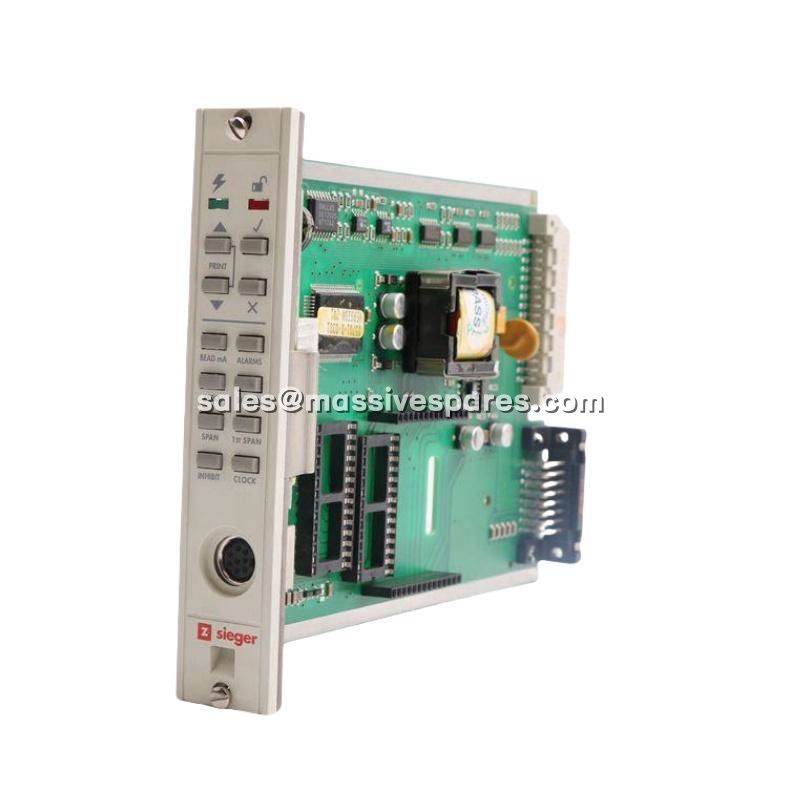
Application Scenarios:
An ESD cabinet has a layer of outputs that almost nobody writes about: the ones that are not the shutdown valves. The alarm horn on the panel, the beacon on the field junction box, the “trip first-out” lamp, the interposing relay that hands a signal to the DCS, the solenoid on a non-safety utility block. They do not carry the SIL claim, but when one of them fails silently, operators lose the ability to understand what the safety system just did — which is exactly when they need it most.
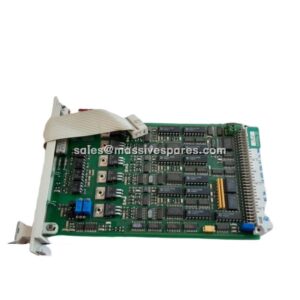
This is the working territory of the 10208/2/1. Its ten potential-free contacts give a designer a clean, isolated way to drive exactly these auxiliary and indication loads from the FSC rack: resistive loads like lamps and indicators, and inductive loads like solenoids, provided an external suppression diode is fitted. Because the contacts are potential-free, each one can switch a circuit on whatever supply the plant already provides at that panel, without importing the FSC’s internal 5 V or 24 V rails into the field loop.
The second scenario is the one that protects your safety case. Every 10208/2/1 output is also controlled by the system watchdog: when the system shuts down and the watchdog switches off, the relays de-energize. So while the module is explicitly not a fail-safe output channel, it still behaves coherently with the rest of the FSC on a system-level shutdown instead of latching a stale alarm state that contradicts the plant condition. During commissioning and proof testing, that predictable de-energized state makes it straightforward to verify an entire annunciator and interposing layer in one step — switch the watchdog, watch the contacts drop, confirm the panel goes quiet.
Parameter:
| Main Parameters | Value/Description |
|---|---|
| Product Model | 10208/2/1 (general type number 10208/2/1 11800) |
| Manufacturer | Honeywell — FSC (Fail Safe Controller) I/O family |
| Product Category | Relay output module, potential-free (dry) contacts |
| Output Channels | 10 independent relay contact outputs, common plus normally open terminal per channel |
| Contact Rating | Maximum 2 A per channel |
| Maximum Switching Voltage | 30 V AC / 36 V DC — IEC 1010 (1990), overvoltage category 3, Table D.12 |
| Maximum Switched Power | 100 W / 1000 VA; application loads up to 70 W |
| Contact Material | Gold-flush silver-cadmium oxide — stable contact resistance on low-current signal loads |
| Load Types | Resistive (lamps, indicators) and inductive (solenoids); inductive loads require an externally mounted suppression diode |
| Watchdog Behaviour | Outputs controlled by the watchdog — relays de-energize on system shutdown; WDG input current 4 mA |
| Power Requirements | 5 V DC at 25 mA and 24 V DC at 120 mA from the FSC rack supply |
| Software Requirement | FSC software version 3.00 or later |
| Space Requirements | 4 TE, 3 HE (4 HP, 3U) in a standard 19-inch FSC I/O rack |
| Key Coding | Module code: holes A9, C17; rack code: large pins A9, C17 (SOURIAU 5159 coding) |
| Approvals | CE, TÜV, UL |
| Environmental Rating | 0 °C to +60 °C operating; −25 °C to +80 °C storage; 95% RH non-condensing; 15 G shock, 1 G vibration to 150 Hz |
| Safety Limitation | Outputs are not tested and may therefore not be used for fail-safe applications |
Technical Principles and Innovative Values:
Innovation Point 1: Ten potential-free contacts instead of a shared-commons digital output.
Each 10208/2/1 channel exposes a common and a normally open terminal with no internal connection to the FSC supply. That is what lets one card switch circuits on several different external voltages and phases — 24 V DC annunciators, a 30 V AC beacon, an interposing coil on a separate supply — without any of them sharing a reference they should not share.
Innovation Point 2: Gold-flush silver-cadmium oxide contacts chosen for mixed load duty.
The contact material is not a generic specification. Gold flashing keeps contact resistance low and stable on the small signal currents typical of indication and interposing circuits, while the silver-cadmium oxide body carries the 2 A switching capability. The result is one contact technology that behaves properly whether it is breaking 20 mA to a lamp driver or 2 A to a solenoid.
Innovation Point 3: Watchdog-controlled de-energization as a system-coherency feature.
The 10208/2/1 draws only 4 mA of watchdog input current, but that connection gives it something disproportionately valuable: when the FSC shuts down and the watchdog switches off, the relays drop out. Alarm and interposing states therefore cannot survive a system shutdown and misrepresent a de-energized plant as still healthy.
Innovation Point 4: Mechanical key coding that makes mis-insertion physically impossible.
Factory-coded holes at A9 and C17 mate only with large pins at the same positions on the rack connector. A technician cannot insert the 10208/2/1 into a slot pinned for a different module type, and resistance on insertion is a definitive signal of a keying mismatch rather than something to be forced. In a rack where a wrong card can silently change the behaviour of a safety output, this is one of the cheapest forms of protection available.
Innovation Point 5: Honest, documented limitation rather than an inflated safety claim.
The datasheet states plainly that the 10208/2/1 outputs are not tested and therefore may not be used for fail-safe applications. That candour is a design asset: it tells the engineer exactly where the module belongs — alarm, indication, interposing and general controlled switching — and keeps the fail-safe output path on the properly tested modules designed for it.
Innovation Point 6: Plug-and-play 10xxx/2/x series membership.
As a 10xxx/2/x module, the 10208/2/1 installs into a prepared backplane slot with factory-defined key coding and requires no hardwired addressing or configuration jumpers. Replacement is a physical swap, not an engineering exercise.