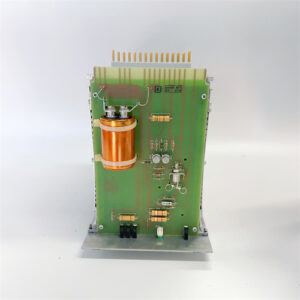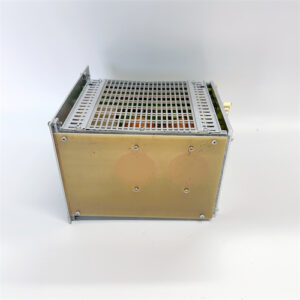
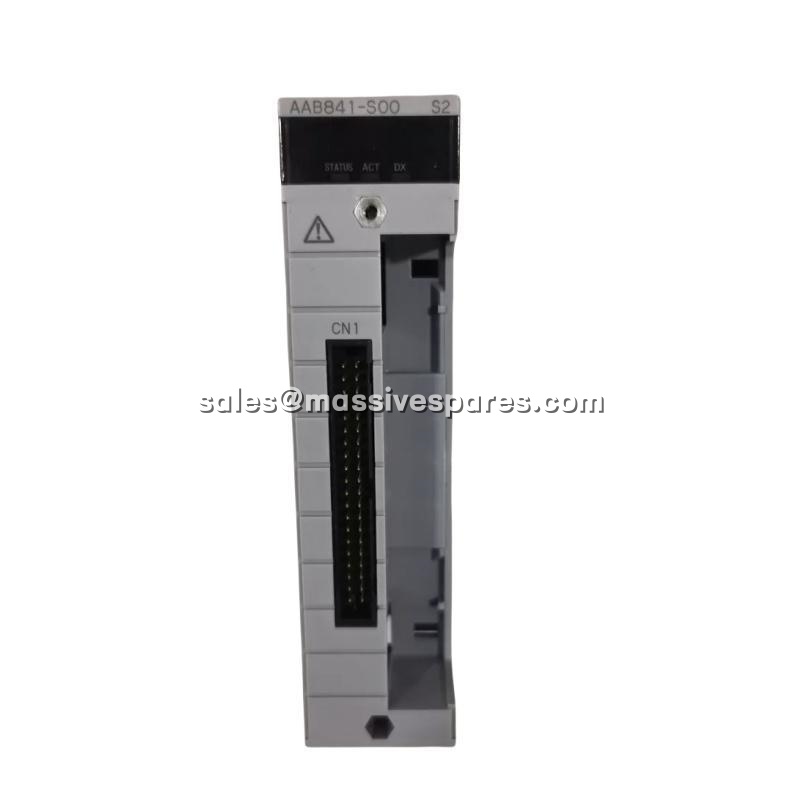

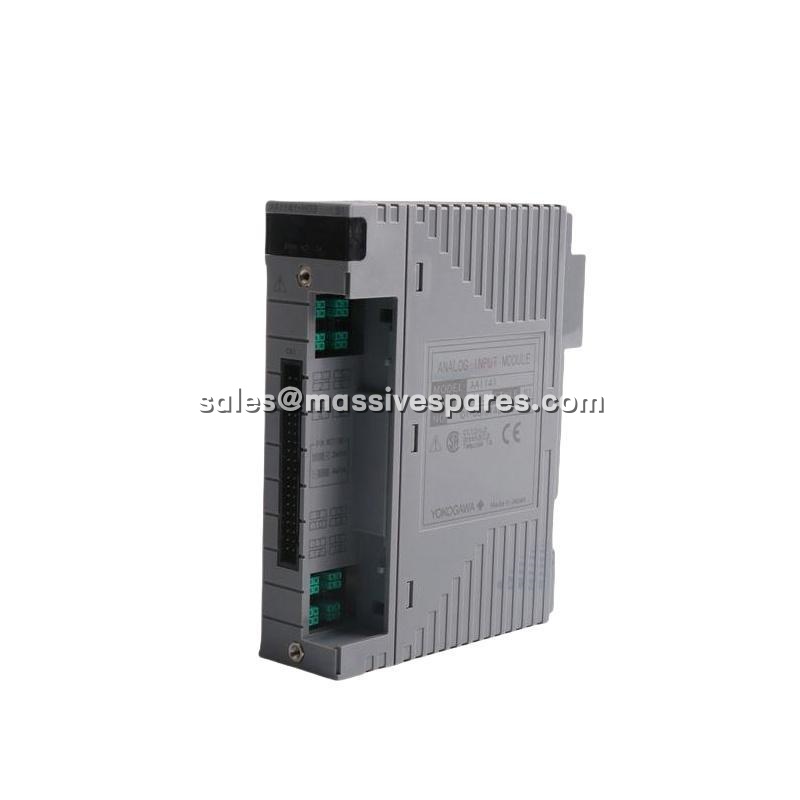
Description
Application Scenarios
A Middle East gas-compression facility was expanding a four-compressor train and discovered that its existing ESB node unit had exactly one free slot left for eight new pressure and temperature indicators plus eight new recycle-valve demand signals. Installing four single-function cards was not an option. The engineering team specified the YAB841 — two cards gave them 16 inputs and 16 outputs, and the slot count dropped from “impossible” to “two spares still free.” More importantly, the 10 ms data update period meant that input scan and output refresh occurred on the same control-task cycle, so the PID block no longer had to wait a scan for fresh PV data. Commissioning reported stable loops on the first tune, with no channel-cross-talk alarms during the 72-hour reliability run.
That project also exposed the one rule this module will not forgive: it expects a shared reference. When one contractor landed instrument screens on a separate earth mat 40 metres away, the common-mode voltage crept above the ±1 V limit and three input channels drifted together. Moving the screen bond to the cabinet reference brought every channel back inside ±4 mV — a ten-minute wiring fix that the card’s diagnostics had already pinpointed.
Parameter
| Main Parameters | Value / Description |
|---|---|
| Product Model | AAB841 (suffixes: -S00 standard, -S50 HART, -S03 G3 + extended temp) |
| Manufacturer | Yokogawa Electric Corporation |
| Product Category | Combined Analog Input / Output Module (FIO) |
| I/O Configuration | 8 inputs / 8 outputs — input and output functions occupy the same slot |
| Input Signal | 1 to 5 V DC, differential input, non-isolated |
| Output Signal | 4 to 20 mA DC, common terminal per side, non-isolated |
| Allowable Input Voltage | ±7.5 V DC — protects the front end against accidental loop surges |
| Allowable Common-Mode Voltage | ±1 V or less — the real wiring limit for this architecture |
| Input Resistance | ≥1 MΩ powered / ≥340 kΩ unpowered — does not load the source signal |
| Allowable Output Load | 0 to 750 Ω — covers 250 Ω, 500 Ω and most valve positioners |
| Input Accuracy | ±4 mV across the 1–5 V range |
| Output Accuracy | ±48 μA (±0.1 % of 4–20 mA span) |
| Data Update Period | 10 ms — input and output refreshed each control cycle |
| Step Response | Input 100 ms (10–90 %); Output 40 ms (10–90 %) |
| Circuit-Open Detection | Triggers below 0.65 mA — detects broken field loops, not just low value |
| Temperature Drift | ±0.1 % of span per 10 °C — about ±4 mV on the input range |
| 2-Wire / 4-Wire Selection | Setting pin on each channel |
| Current Consumption | 310 mA at 5 V DC, 250 mA at 24 V DC |
| Signal Connection | Pressure clamp terminal board, KS dedicated cable, or MIL connector cable |
| HART Capability | Available on the -S50 suffix (current input and output channels) |
| Physical Size | Approx. 32.8 mm (W) × 130 mm (D) × 107.5 mm (H) |
| Weight | Approx. 0.3 kg |
| Operating Temperature | 0 to 50 °C standard; -20 to 70 °C with the -S03 / G3 option |
Technical Principles and Innovative Values
- One slot, two signal directions. Innovation Point 1: the module is not simply “an analog card” but an input/output pair in a single FIO footprint. Where a conventional design consumes two slots for monitoring and actuating one loop, AAB841 halves that requirement — meaningful when a node unit holds only eight modules and every slot carries a price in panel space, backplane current and cabinet cooling.
- Differential voltage input with megohm-class impedance. Innovation Point 2: the 1–5 V input is differential rather than single-ended, rejecting the small potential differences that appear between instruments landed on different cable trays. The ≥1 MΩ input resistance means the module draws negligible current from the source, so a 250 Ω shunt resistor converts 4–20 mA to 1–5 V with predictable accuracy and the original transmitter calibration is not disturbed.
- 10 ms update aligned to the control task. Innovation Point 3: the data update period is the same order as a typical FCS control scan. Input conversion and output刷新 share one timing reference, which removes the “stale PV” condition that appears when input and output cards run on different clocks. The output step response of 40 ms is deliberately faster than the 100 ms input response — the module drives the actuator quickly and waits for the process to answer, matching the physics of a valve rather than fighting it.
- Broken-wire detection is a real number, not a status bit. Innovation Point 4: circuit-open detection is specified at less than 0.65 mA. On a 250 Ω termination that is 162.5 mV, sitting clearly below the 1 V live-zero of the 1–5 V scale. The system can therefore distinguish “transmitter dead” from “tank empty,” and a failed input drives a defined output rather than letting the loop hunt.
- Per-channel 2-wire / 4-wire selection by pin. Innovation Point 5: transmitter excitation is set on the card itself, so the same eight channels can mix self-powered 4-wire analysers with 2-wire loop-powered transmitters. The module does not generate transmitter supply, which keeps the thermal load low — a point that matters when eight output channels are already dissipating 15 V across a 750 Ω load.
- HART without a separate communicator, on the -S50 variant. Innovation Point 6: the -S50 suffix places HART digital communication on the current input and output channels, allowing device configuration, calibration data and diagnostics to travel over the same pair that carries the 4–20 mA signal. Configuration changes move from a manual field visit to a workstation task, and device health becomes visible before a loop fails.
- Migration, not replacement. Innovation Point 7: in Yokogawa’s RIO System Upgrade path, a legacy AMC80 multipoint analog I/O module maps directly to the AAB841-SK□, with the existing KS cable interface retained. The plant keeps its field termination and replaces the obsolete multiplexer with a current-technology module — the lowest-risk form of obsolescence management.
Application Cases and Industry Value
Refinery fuel-gas header — closed-loop pressure control. A South-East Asian refinery used the AAB841 to replace four ageing multiplexer cards on a fuel-gas pressure header. Eight 1–5 V signals from d/p cells and temperature elements entered the card; the same card drove eight 4–20 mA outputs to valve positioners on the pressure-letdown and burner-management valves. The 40 ms output step response let the operators tighten the PID tuning without oscillation, and the common-mode differential input removed a long-standing low-level ripple that had previously been blamed on the transmitters. After the change, the monthly loop-performance report showed three fewer out-of-limits excursions and the instrumentation team stopped carrying a HART communicator to that area — configuration was done from the engineering station.
Onshore compression skid — cabinet space and commissioning time. An EPC contractor building a three-skid compressor package chose the AAB841 for the local FIO node unit because each skid required 24 analog inputs and 24 outputs but carried only a 4-slot allowance. Three modules per skid covered the requirement with one slot free, and the KS-cable termination meant the skid vendor could complete all wiring off-site while the DCS rack was still in transit. The -S00 variant was specified for the clean indoor environment; a sister unit in the sour-gas area used the -S03 / G3 option for the -20 to 70 °C rating and corrosive-atmosphere protection. Commissioning time on the second and third skids fell by roughly 30 % once the wiring team had learned the single termination pattern — a direct maintenance and project-cost benefit.