
Description
Technical Specifications
| Parameter | Value |
|---|---|
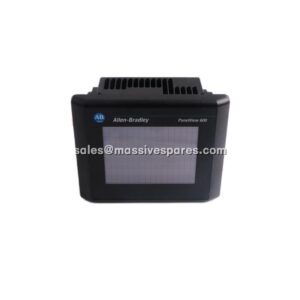
| Product Model | 2711-K5A1/A (Series A) |
| Manufacturer | Allen-Bradley / Rockwell Automation |
| Product Type | PanelView 550 Standard Operator Terminal (HMI), keypad only |
| Display Type | Monochrome transflective LCD, blue mode, LED backlight |
| Display Area | 120 × 60 mm (4.75 × 2.38 in.) |
| Resolution | 256 × 128 pixels |
| Viewable Size | 5.5 in. diagonal |
| Operator Input | Keypad only — no touchscreen (10 function keys F1–F10, numeric, navigation) |
| Keypad Life | 1 million actuations (stainless-steel domed membrane) |
| Application Memory | 170 KB runtime; 240 KB nonvolatile (objects, text, bitmaps) |
| Communication Port 1 | Remote I/O (RIO), 3-terminal Phoenix-style, daisy-chain |
| Communication Port 2 | RS-232 (DB-9 female, DCE) — application transfer and printer |
| Real-Time Clock | Battery-backed, for timestamped alarms and events |
| Input Power | 85–264 VAC, 47–63 Hz, 45 VA maximum |
| Dimensions (H × W × D) | 167 × 266 × 106 mm (6.57 × 10.47 × 4.17 in.) |
| Weight | 1.20 kg (2.65 lb) |
| Enclosure Rating | NEMA Type 12/13, 4X (indoor); IP54 / IP65 front |
| Operating Temperature | 0…55 °C (32…131 °F) |
| Storage Temperature | -40…70 °C (-40…158 °F) |
| Humidity | 5…95% non-condensing |
| Programming Software | PanelBuilder32 (.pba / .pva application files) |
| Status Indicators | COMM (green), Fault (red) |
| RIO Trunk Cable | Belden 9463 (shielded, 1 twisted pair) |
| Lifecycle Status | Discontinued / obsolete — spare, refurbished and repair support |
Main Features and Advantages
Purpose-built input, not a touchscreen bolted onto a small screen. The 2711-K5A1/A gives the operator ten labelled function keys plus a numeric and navigation cluster, and because the keys are physical stainless-steel-domed membranes you feel the actuation. On a cold-start morning, with nitrile gloves, oil mist or a vibrating guard in the way, that is worth more than a glass surface. There is no touch-cell calibration to drift, no overlay to scratch and no ambiguity about which object was touched — F1 starts the cycle, F2 acknowledges the alarm, and the numeric pad enters the setpoint directly. For a machine that runs the same fifty actions a shift, the keypad is faster than any GUI.
Remote I/O is the quiet advantage of this particular suffix. Where a DH-485 PanelView must be addressed, baud-matched and troubleshooted as a serial node, the 2711-K5A1 simply joins the RIO trunk. To the PLC-5 or SLC 500 scanner it is another I/O rack, so the familiar block-transfer logic moves integer and bit data between ladder and screen with no DH-485 node table and no DF1 handshaking to diagnose. That is a real benefit on an installed line: the electrician already understands the RIO drop, the spare cable is already on the reel, and a screen swap does not turn into a network commissioning job. It also means the HMI traffic rides the same deterministic backbone as the rest of the I/O, which matters when the machine cannot afford a serial retry.
The separate RS-232 printer port is unfashionable and genuinely useful. Point it at a serial matrix or receipt printer and the 2711-K5A1/A can emit alarm lists, event logs and shift summaries on demand or on fault, giving you a controller-independent paper record. In food, pharmaceutical and batch applications that is often the difference between an audit trail you can hand an inspector and one that lives only on a PC somebody forgot to back up. The same port is your application-transfer path, so a known-good .pba loaded through a straight-through DB-9 cable is all you need to clone a terminal.
Rugged and power-agnostic by design. The LED backlight is rated at 100,000 hours, so the usual failure mode is not a burnt lamp but a dirty screen or a tired keypad membrane. The wide 85–264 VAC input shrugs off control-transformer taps, phase imbalance and international site power, and the sealed front bezel takes coolant mist, washdown and solvent wiping without letting the cabinet breathe. Two LEDs do the first line of fault-finding for you: green COMM confirms the RIO drop is alive, red Fault tells you to look at the terminal before you blame the PLC. For a discontinued platform, that field-diagnosable simplicity is the reason plants keep a tested 2711-K5A1/A on the shelf.
Application Field
The 2711-K5A1/A is at home on a single machine or a compact skid where the operator needs to see state, enter a number and press a button — and where the control system is already a PLC-5, SLC 500 or other RIO-scanner architecture. On a press, stamping line, feeder or cut-to-length machine it shows part count, stroke and fault code, accepts the next job length from the numeric pad and lets the setter move through setup screens with cursor keys while keeping both hands away from the touch surface. Because the interface is keypad-only, the screen layout stays deliberately simple: one glance tells the operator what is running, one key clears the alarm, and there is no accidental navigation into a diagnostic page.
Packaging, filling, capping and conveying lines use the 2711-K5A1 for exactly the same reason. The monochrome display is bright enough to read speed, reject count, magazine level and interlock status; the ten function keys map onto start, stop, jog, reset, recipe select and manual modes; and the RS-232 printer produces a shift-end ticket or a rejected-batch record without involving the site network. In washdown and food-grade areas the sealed front and the physical keys beat a touchscreen — you wipe the membrane with the same cloth you use on the guard, and the key action still clicks. The same profile fits water and wastewater lift stations, where a local panel must show pump rotation, valve position and level independently of the SCADA link.
OEMs specified the 2711-K5A1/A in quantity because the PanelView 550 footprint, the RIO wiring and the PanelBuilder32 project were proven across an entire machine range. Service calls are short: the cutout, the bezel, the connector layout and the application load are identical across the series, so a spare swaps in mechanically and software-identically. Even where a site is planning a longer-term move to PanelView Plus and EtherNet/IP, holding a verified 2711-K5A1/A in stores is the difference between a thirty-minute repair and a panel-rebuild migration. It is also the pragmatic answer for a machine that will never justify a migration project: the HMI works, the ladder is stable, and the only rational spend is keeping the terminal alive.