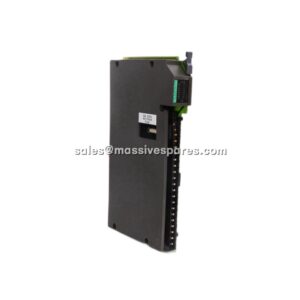
Description
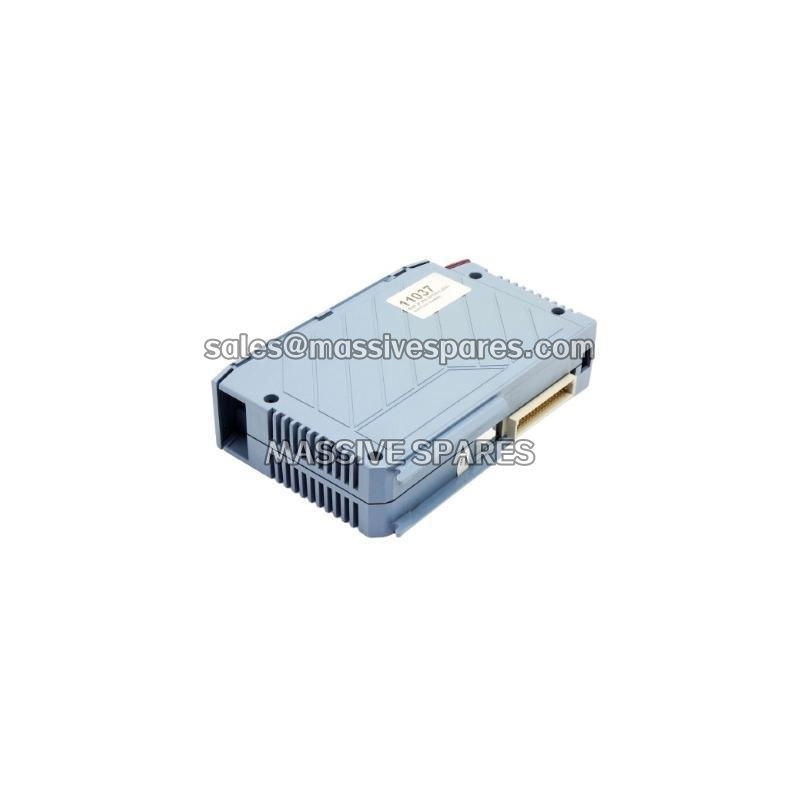
Technical Specifications
| Parameter | Value |
|---|---|
| Product Model | 3IF050.6-B.R |
| Manufacturer | B&R Industrial Automation (ABB Group) |
| Product Type | Serial Communication Interface Module |
| Applicable System | B&R System 2005 PCC (main and expansion rack) |
| Carrier / Slot | IF050 system module interface slot, single-width |
| Port 1 | 1 × RS232 (9-pin D-sub, point-to-point) |
| Port 2 | 1 × RS485 / RS422, network-capable (multi-drop) |
| Port 3 | 1 × RS232 / TTY (20 mA current-loop capable) |
| Electrical Isolation | All ports mutually isolated and isolated from backplane |
| Supply Voltage | 24 V DC via 2005 rack backplane |
| Status Indication | Per-port Rx / Tx LEDs |
| Operating Temperature | 0 °C to +55 °C |
| Storage Temperature | -40 °C to +70 °C |
| Mounting | 2005 rack plug-in (not standalone DIN-rail) |
| Certifications | CE, UKCA, UL / cULus E115267 |
| Accessories | 0G1000.00-090 RS485 bus connector; 0AC916.9 active RS485 terminator |
Main Features and Advantages
Three isolated serial worlds, one rack slot: The B&R 3IF050.6-B.R does not merely add three COM ports; it adds three electrically independent communication domains. Port 1 typically services a barcode reader, handheld terminal, or service laptop; Port 2 forms a multi-drop RS485/RS422 network to weigh scales, inverters, or remote I/O; Port 3 revives a 20 mA TTY current-loop device such as an older drive, printer, or machine-tool interface. Because each port rides behind its own isolation barrier, a ground-loop current from a 1980s drive cannot contaminate the scale bus, and a shorted RS485 cable cannot pull down the backplane. In retrofit work, where mixed generations of equipment share one frame, this is the difference between a stable machine and a chronic “comm loss” fault.
Backplane-powered and cabinet-native: The B&R 3IF050.6-B.R takes its operating power from the 2005 system bus, eliminating the external 5 V or 12 V wall adapter that plagues dongle-based serial extensions. There is no FTDI chip to lose its driver after a Windows update, no USB host to crash, and no loose cable tie-wrapged to the cabinet door. Once seated in the IF050 carrier, the module is mechanically captive, screened, and serviced like every other 2005 module—critical for validation and change-control regimes in regulated industries.
Network-capable RS485/RS422 port: Port 2 is specified by the manufacturer as network-capable, meaning it is intended for daisy-chained, multi-node topologies rather than a single point-to-point link. A single B&R 3IF050.6-B.R can therefore replace a handful of single-port interface cards and the repeaters or converters that would otherwise be needed to reach a dozen field nodes. Fit the 0G1000.00-090 bus connector at the trunk and terminate the far end actively with the 0AC916.9 when the drop is long or runs past VFD-heavy skids; the result is a deterministic, noise-immune field bus that costs a fraction of an industrial Ethernet conversion.
TTY current-loop preservation: Port 3 is the quiet differentiator. True 20 mA TTY current-loop signaling is poorly served by generic USB-serial adapters, which generally output voltage levels only. The B&R 3IF050.6-B.R accommodates the loop directly, letting a plant retain a functioning legacy drive, teleprinter, or terminal without an obscure bespoke converter. For a machine whose mechanical life still exceeds its electronics life, that capability is what keeps the line running rather than becoming a museum piece.
Diagnostics at a glance: Independent Rx and Tx LEDs for each port give the maintenance team an immediate answer to the first troubleshooting question—”is anything being transmitted?” A dark Tx LED during a known poll identifies a dead master-side configuration; a permanently lit Rx LED points to a stuck or noisy slave. Combined with the B&R PVI monitor and Automation Studio’s serial debug facilities, the B&R 3IF050.6-B.R reduces mean time to diagnose (MTTD) to minutes rather than shifts.
Software-transparent integration: Configuration is performed with the same serial function blocks used elsewhere in the 2005 application, so baud rate, data bits, parity, stop bits, and handshake are set in the project, not discovered by trial and error at the terminal. The B&R 3IF050.6-B.R therefore introduces no new runtime dependency and no new failure mode in the control task, which matters on a twenty-year-old application where the original source may be the only documentation that still exists.