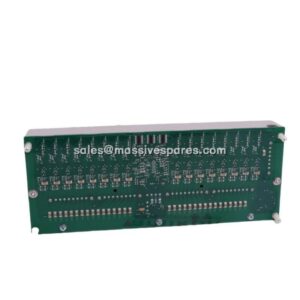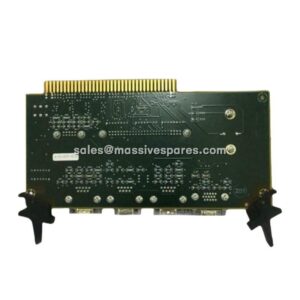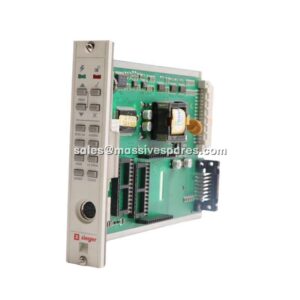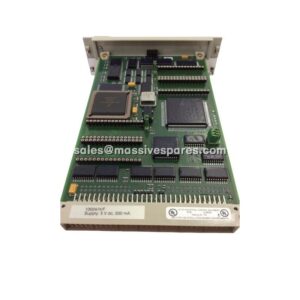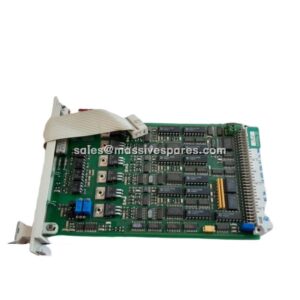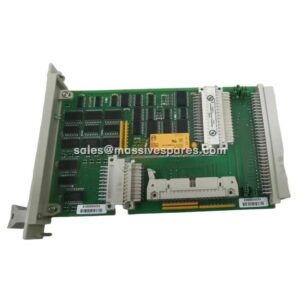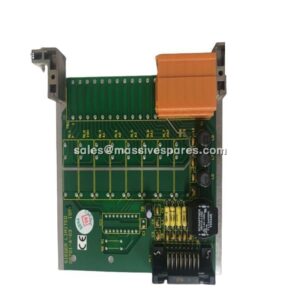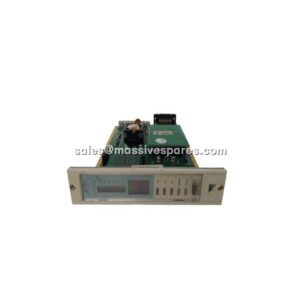

Description
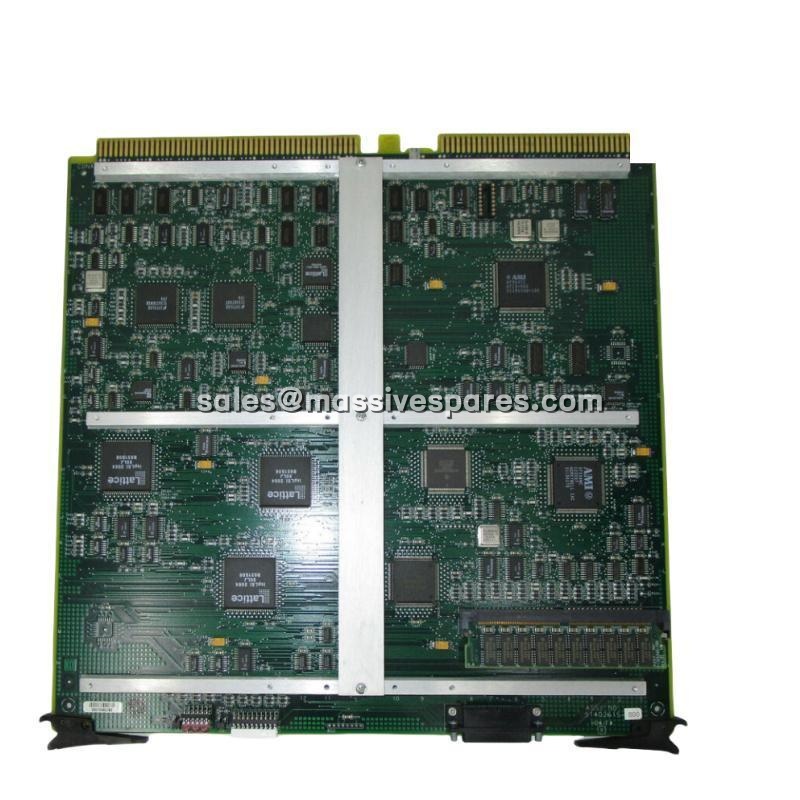
Technical Specifications
| Parameter Name | Parameter Value |
|---|---|
| Product Model | 51402615-400 (K2LCN-4 / PWA K2LCN-4) |
| Manufacturer | Honeywell Process Solutions |
| Product Type | Motherboard / LCN Node Interface PC Board |
| Compatible Platform | TDC 3000 / TPS (Local Control Network) |
| Related Series | Honeywell / Measurex control systems |
| Memory Capacity | 4 Megawords |
| Network Interface | Honeywell LCN (coaxial token-passing highway) |
| Power Supply | DC, supplied via chassis backplane |
| Form Factor | Plug-in PCB module (card-slot insertion) |
| Dimensions (L×W×H) | 366 × 363 × 20 mm (approx. 36.6 × 36.3 × 2 cm) |
| Weight | Approx. 0.92 kg (920 g) |
| Operating Temperature | 0°C to +60°C |
| Certifications | CE / UL / CSA |
| Country of Origin | United States |
| Product Status | Discontinued / Legacy (obsolete) |
Main Features and Advantages
High-density 4-megaword memory: The defining capability of the Honeywell 51402615-400 is its 4-megaword onboard memory architecture. This provides the capacity required for continuous real-time data storage, control execution, and the buffering of LCN communication frames—enabling the board to support complex, high-density process-control tasks without external memory expansion.
Precision signal-integrity design: The multi-layer PCB uses controlled-impedance traces and ground-plane noise-suppression layers to minimize crosstalk and signal distortion. Channel-to-channel isolation embedded directly in the board layout eliminates ground-potential interference, preserving data accuracy in dense, electrically noisy DCS node environments.
Central backplane interconnect: As a true motherboard, the Honeywell 51402615-400 distributes stable power, accurate clocking, and reliable data pathways to every daughter card in the node chassis. This centralized, predictable interconnect ensures that downstream modules function without unintended signal interference or timing skew.
Deterministic LCN communication: The board interfaces directly with the Honeywell LCN coaxial highway, handling high-speed peer-to-peer communication between Universal Stations, AM, HM, NIM, and UCN Gateway nodes. This restores full operator visibility, alarm handling, and historian data flow across the network segment.
Direct drop-in replacement: Engineered to slot straight into existing TDC 3000 / TPS node chassis, the Honeywell 51402615-400 requires no cabinet modification, no rewiring, and no control-strategy re-engineering. This minimizes installation time during critical maintenance windows and dramatically reduces mean time to repair.
Industrial-grade ruggedization: Constructed with high-reliability components and a reinforced PCB substrate, the motherboard tolerates the humidity, dust, vibration, and thermal cycling typical of continuous-duty control cabinets. CE, UL, and CSA compliance provide assurance of global safety and quality conformance.
Long-service, low-maintenance design: The board is engineered for 24/7 continuous operation with minimal scheduled maintenance. When a verified spare is on the shelf, a failing unit can be swapped quickly, keeping decades-old TDC 3000 infrastructure operational indefinitely.
Application Field
The Honeywell 51402615-400 is deployed wherever a TDC 3000 or TPS system relies on the LCN as its communication spine. In petroleum refineries and petrochemical complexes, it supports the processor and communication nodes that control distillation columns, cracking units, reactors, and tank-farm inventory systems. A healthy LCN node board is essential to maintaining operator visibility and control across these critical units—its failure can degrade or halt data exchange across an entire network segment.
In power-generation facilities—including coal, gas-turbine, and combined-cycle plants—the Honeywell 51402615-400 powers boiler-management and turbine-control DCS nodes, where stable memory execution and deterministic communication are vital to safe operation. Fertilizer plants use it in ammonia and urea reaction-line control, while pharmaceutical manufacturers rely on it in validated batch fermentation and purification processes where preserving the existing control architecture is part of maintaining cGMP compliance.
Pulp and paper mills deploy the board in continuous digester and recovery-boiler automation, and steel and metals plants use it in blast-furnace and rolling-mill control. Water and wastewater treatment facilities incorporate it into large-scale SCADA/DCS hybrid architectures. Beyond day-to-day operation, the Honeywell 51402615-400 is heavily specified for emergency fault repair—such as a failed memory subsystem, LCN communication loss, or degraded node board—and as part of preventive spare-stocking programs. Because it preserves the original node chassis form factor, backplane connector, and LCN address configuration, it allows plants to defer the $3–8 million and 18–36 month commitment of a full DCS migration to a planned, budget-controlled timeline.