
Description
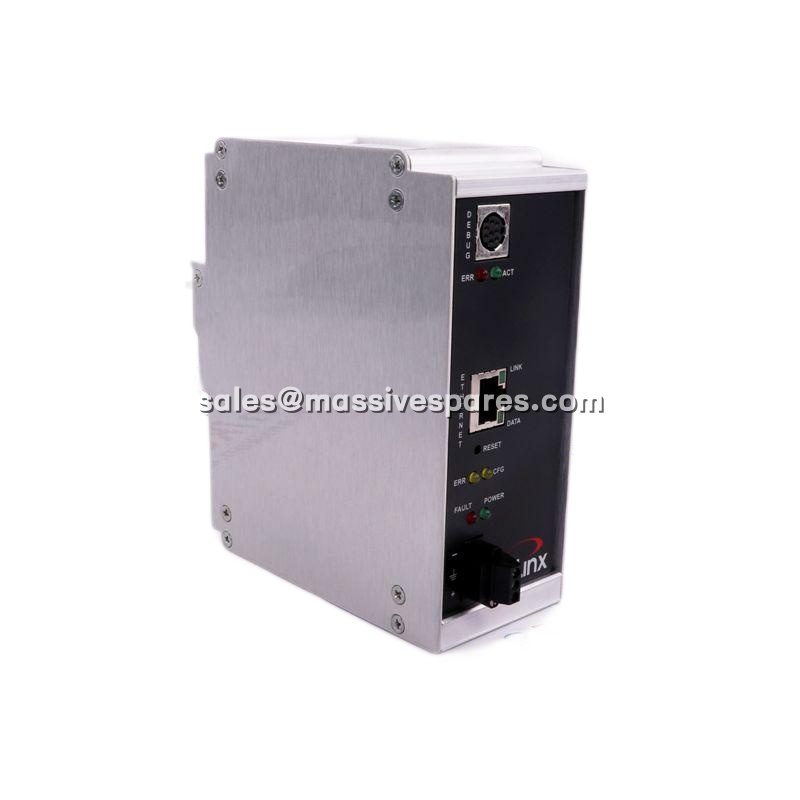
Application Scenarios:
A municipal water treatment authority operates a filter plant where the original GE Series 90-30 PLCs still control the backwash sequence reliably, while every newer skid, chemical feed system and the plant SCADA layer is Rockwell. The problem is not that either platform is failing — it is that the Rockwell side cannot see backwash status, filter differential pressure or valve positions without a hardwired interposing relay panel, and the GE side cannot receive setpoints or permissives from the newer system.
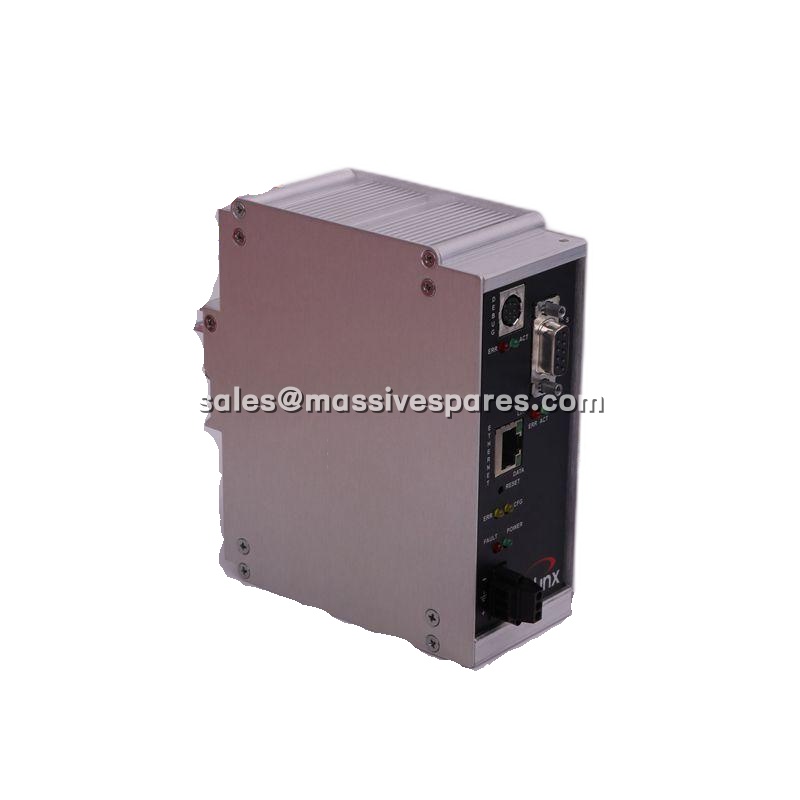
This is the gap 5201-DFNT-EGD fills. Installed on a DIN rail in the control room and wired into the existing Ethernet switch, it consumes EGD exchanges produced by the GE CPU364 and places that data into its internal database, where a ControlLogix 1756-EN2T reads it with standard explicit messages. In the other direction, the ControlLogix writes setpoints into the gateway, and 5201-DFNT-EGD produces them as an EGD exchange the GE PLC consumes natively. No PLC code changes, no new I/O cards, no relay panel.
The pain points it removes are consistent across these projects: the cost and outage risk of a full PLC migration, the maintenance burden of hardwired interposing, the inability of SCADA to trend data trapped in a legacy controller, and the “nobody knows how to program that old GE” staffing risk. For plants running GE drives, turbines or CIMPLICITY HMIs on EGD, 5201-DFNT-EGD extends the useful life of that installed base instead of forcing replacement.
Parameter:
| Main Parameters | Value/Description |
|---|---|
| Product Model | 5201-DFNT-EGD |
| Manufacturer | ProSoft Technology (Belden brand) — ProLinx 5000 Series |
| Product Category | Standalone DIN-rail protocol gateway / EtherNet/IP to GE EGD converter |
| Protocols Supported | EtherNet/IP (Explicit Messaging, Client and Server) + GE Ethernet Global Data — one shared Ethernet port |
| EtherNet/IP Role | User-configurable as Client, Server, or both simultaneously |
| EtherNet/IP Server Capacity | 5 independent TCP server sockets; data table file fixed at N10; file size 100 or 1,000 words |
| EtherNet/IP CIP Services | 0x4C CIP Data Table Read, 0x4D CIP Data Table Write — note: Implicit (I/O) messaging is NOT supported |
| EtherNet/IP Client Capacity | 1 client with a command list of 100 commands; polling configurable as disabled, continuous, or on change of data (writes) |
| EGD Exchanges | Up to 100 producer or consumer exchanges defined in the exchange list |
| EGD Exchange Size | 1–700 registers per exchange; database start register 0–3999; register + start must not exceed 4,000 |
| EGD Cast Types | Producer: Broadcast, Multicast, Unicast. Consumer on failure: no change, DB = −1, DB = 0, or DB = 1 |
| EGD Ports and Transport | UDP; producer/consumer service port 18246; command service port 7937 (0x1F01); max command message 1,400 bytes |
| EGD Command Support | Codes 3, 4, 7, 8, 9, 10, 15, 16, 18, 32, 33, 34, 35, 36, 37 — including masked write for bit-level changes |
| Internal Database | 4,000 × 16-bit word registers, shared by both drivers; swap codes 0–3 for byte/word ordering |
| Ethernet Interface | 1 × RJ45, 10Base-T half duplex per ProSoft hardware specification, with link and activity LEDs |
| Electrical Isolation | Ethernet 1,500 V rms at 50–60 Hz for 60 s (IEC 60950:1991 §5.3.2); serial port 2,500 V rms per UL 1577, 3,000 V DC port-to-ground and port-to-logic |
| Broadcast Storm Resiliency | Withstands ≤5,000 ARP frames per second for up to 5 minutes — survives switch faults and network loops |
| Power Supply | 24 V DC nominal, 18–32 V DC allowed; Positive, Negative, GND terminals; 2.5 mm screwdriver blade; 500 mA max @ 32 V DC |
| Configuration | ProSoft Configuration Builder (PCB); DB-9M RS-232 configuration port, no hardware handshaking; also supports wattcp.cfg and plain-text configuration files |
| Diagnostics | LED indicators for Power and Module Status, Application Status, Serial Port Activity, Serial Port Error Status |
| Operating Temperature | −20 °C to 50 °C (−4 °F to 122 °F); storage −40 °C to 85 °C |
| Relative Humidity | 5% to 95%, non-condensing |
| Dimensions | Standard: 5.20 H × 2.07 W × 4.52 D in (13.2 × 5.25 × 11.48 cm); Extended: 5.20 × 2.73 × 4.52 in |
| Installation Method | Standalone DIN-rail mounting in an extruded aluminium enclosure; ships with RJ45-to-DB-9M cables, 6 ft RS-232 configuration cable and 2.5 mm screwdriver |
Technical Principles and Innovative Values:
Innovation Point 1: A shared database instead of point-to-point mapping. Both drivers in 5201-DFNT-EGD read from and write to the same 4,000-word internal register space. Data arriving from an EGD producer is immediately available to an EtherNet/IP client read, and a value written by a ControlLogix message is immediately available to produce. There is no intermediate mapping table to maintain, and adding a data point is a configuration change rather than a code change.
Innovation Point 2: Both sides configurable as client or server, in the same unit. The EtherNet/IP driver on 5201-DFNT-EGD can poll up to 100 commands as a client while simultaneously answering five independent TCP server sockets. That dual personality means the gateway can be the initiator on one side and the responder on the other, or the initiator on both — which is what makes bidirectional control, not just monitoring, possible between Rockwell and GE hardware.
Innovation Point 3: EGD producer/consumer semantics preserved end to end. Rather than poll-and-reply, 5201-DFNT-EGD participates in EGD as a real peer: it produces exchanges on a user-defined period to a unicast, multicast or broadcast address, and it consumes exchanges with configurable failure behaviour. If a consumed exchange stops arriving, the database can be set to 0, 1, −1 or left unchanged, so the Rockwell side sees a defined, safe value rather than stale data.
Innovation Point 4: Command services for non-periodic data. Beyond periodic exchanges, 5201-DFNT-EGD responds on UDP port 7937 to read, write and masked-write requests for data that does not need continuous updating. Setting an exchange’s production time to zero turns it into a command-only exchange — an elegant way to expose configuration and setpoint data without consuming bandwidth on repetitive transfers.
Innovation Point 5: Designed for the failure modes of real networks. The Ethernet port on 5201-DFNT-EGD carries 1,500 V rms isolation and is rated to survive broadcast storms of up to 5,000 ARP frames per second for five minutes. In plants where a failed switch or a mis-patched cable floods the network, the gateway rides through the event instead of locking up and taking the data link down with it.
Innovation Point 6: No ladder logic, no PLC downtime. Because the gateway executes the command list itself, data transfer runs without any messaging instructions in the Rockwell processor and without EGD configuration changes in the GE CPU. For a live plant, that means the integration can be commissioned without a processor download — often the single largest risk item in a legacy integration project.