
Description
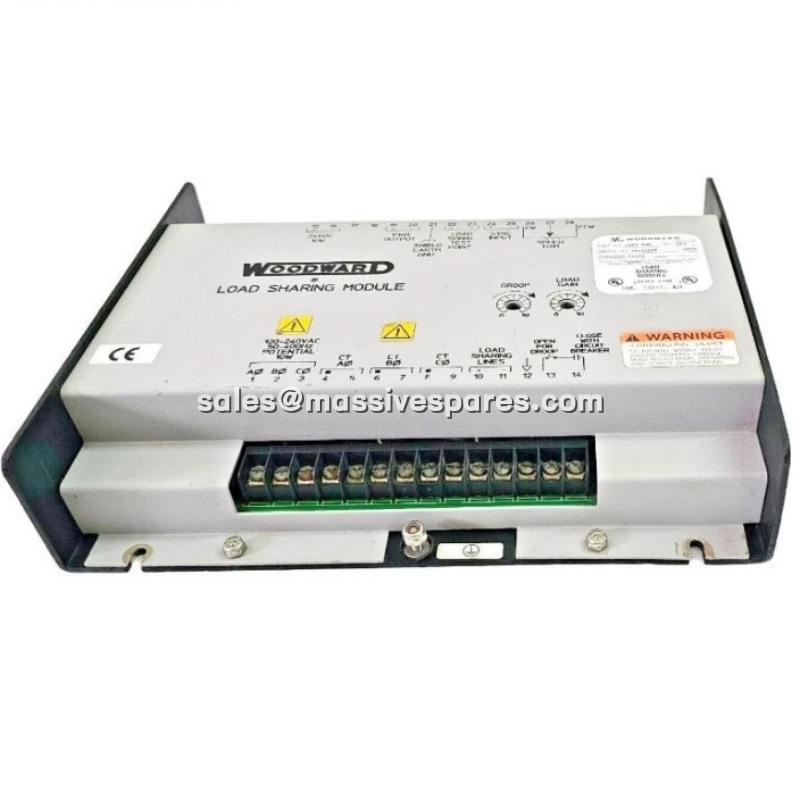
Technical Specifications
| Parameter Name | Parameter Value |
|---|---|
| Product Model | CSC3LG120 |
| Manufacturer | Woodward |
| Product Type | Digital Control / Governor Control Module (CSC3 Series) |
| Supply Voltage | 24 VDC nominal |
| Power Consumption | Approx. 5 W |
| Control Algorithms | PID, feedforward, adaptive control |
| Communication Protocols | CANbus, Modbus (RTU / serial fieldbus) |
| I/O Capability | Configurable digital inputs and outputs for sensors, actuators, and auxiliaries |
| Signal Processing | Real-time actuator-loop feedback and governor signal processing |
| Environmental Operating Temperature | −40 °C to +85 °C |
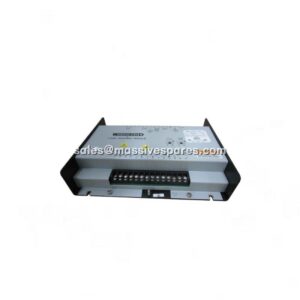
| Enclosure / Protection | Industrial module enclosure; install inside control cabinet or sealed enclosure |
| Mounting | Rack or panel mount within control cabinets and engine control panels |
| Dimensions (L × W × H) | 120 × 100 × 60 mm (4.72 × 3.94 × 2.36 in) |
| Weight | Approx. 1.2 kg (2.65 lb) |
| Certifications | CE, UL listed (model dependent) |
| Country of Origin | USA |
| Warranty | 12 months (supplier-backed) |
Main Features and Advantages
Governor-grade real-time control. The principal capability of the Woodward CSC3LG120 is its ability to close a governor control loop with deterministic timing. By continuously processing speed, load, and process-variable feedback, the module adjusts the actuator drive signal to hold the setpoint through load steps, fuel-quality changes, and ambient disturbances. This is the same class of precise regulation that Woodward is known for in engine and turbine control, making the Woodward CSC3LG120 a strong fit wherever stable speed and load control directly affect plant output and equipment life.
PID, feedforward, and adaptive algorithms in one module. Rather than relying on a single fixed control law, the Woodward CSC3LG120 supports PID control for stable proportional–integral–derivative regulation, feedforward control to anticipate and reject measured disturbances before they affect the process variable, and adaptive control to adjust behaviour as operating conditions change. The combination lets commissioning engineers tune a fast yet stable loop—important in applications such as generator load sharing, compressor control, and engine speed governing, where overshoot, droop, and steady-state error all carry a direct operational cost.
Configurable I/O for flexible system interfacing. The Woodward CSC3LG120 provides configurable digital inputs and outputs, allowing it to be mapped to a wide range of field devices without external signal conditioning in many cases. Digital inputs can accept sensor and switch contacts; digital outputs can drive actuators, solenoids, contactors, and annunciator circuits. This flexibility reduces the number of separate interface components required in the panel and makes the module equally useful as a standalone controller or as a slave module within a larger distributed control architecture.
Industrial communication for networked control. Native CANbus and Modbus support means the Woodward CSC3LG120 can exchange setpoints, process data, status, and alarms with Woodward control platforms and with third-party PLCs, DCS nodes, HMIs, and SCADA systems. This connectivity enables remote monitoring, coordinated multi-unit operation, and integration into plant-wide asset management—without proprietary gateways or complex protocol converters.
Built for harsh environments. The module’s extended −40 °C to +85 °C operating-temperature rating, low 5 W power draw, and rugged industrial enclosure make it suitable for installation in engine control rooms, outdoor packaged equipment, and other demanding locations. Its thermal design avoids performance degradation and signal drift across the full temperature range, while the modular form factor simplifies removal and replacement during planned maintenance or emergency repair. For the Woodward CSC3LG120, reliability is therefore not an accessory feature—it is the basis on which the rest of the control system depends.