
Description
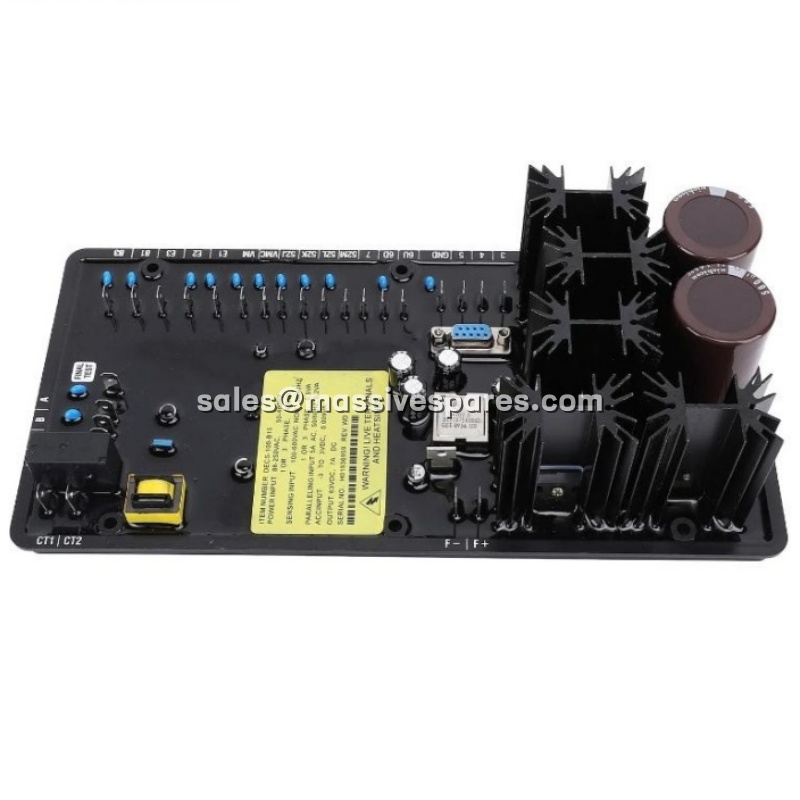
Technical Specifications
| Parameter | Value |
|---|---|
| Product Model | DECS-100-B15 |
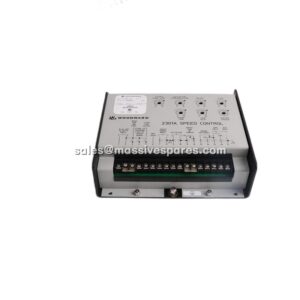
| Manufacturer | Woodward Inc. (orig. Basler DECS-100 platform) |
| Product Type | Digital Automatic Voltage Regulator / Excitation Control System |
| Regulation Accuracy | ±0.25% steady state, no load to full load |
| THD Performance | ≤0.5% regulation accuracy at 40% total harmonic distortion |
| Auxiliary Supply | 88–132 / 176–264 VAC auto-sensing, 50/60/400 Hz |
| Sensing Input | 100/120, 200/240, 400/480, 600 VAC, single or three-phase |
| CT Input | 1 A or 5 A secondary (B15 = 5 A CT configuration) |
| Field Output | 0–63 VDC @ 7 A continuous, PWM |
| Forced Excitation | 135 VDC @ 15 A for 10 seconds |
| Minimum Rotor Resistance | 9 Ω |
| Control Modes | AVR, FCR (manual field current), VAR, PF, droop |
| V/Hz Limiting | 0–3 per-unit adjustable |
| Communication | RS-232 (BESTCOMS), RS-485 Modbus RTU |
| Protection Functions | Overexcitation shutdown & limiting, underexcitation, overvoltage, loss of sensing, underfrequency |
| Operating Temperature | -40 °C to +70 °C |
| Enclosure Rating | IP20 (panel-mount module) |
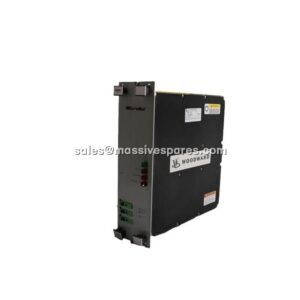
| Approximate Dimensions | 280 × 240 × 85 mm (panel-mount version) |
| Approximate Weight | 3.5 kg |
| Compliance | CE, cULus (UL 508 / CSA C22.2 No.14), DNV, RoHS |
Main Features and Advantages
The Woodward DECS-100-B15 stands out through the combination of measurement precision, operational flexibility and integrated protection. Its ±0.25% steady-state regulation accuracy, maintained even under 40% harmonic distortion, means clean, stable voltage for sensitive loads — a decisive advantage in data centers, offshore platforms and industrial plants where a few volts of deviation can trip downstream equipment.
The 63 VDC / 7 A continuous PWM field output, backed by a 135 VDC / 15 A ten-second forced excitation capability, gives the generator real authority during system disturbances. That short-term boost raises terminal voltage quickly when the grid needs it most, improving transient stability and reducing the risk of protective relay trips. A minimum rotor resistance of 9 Ω covers the vast majority of small to mid-size brushless exciters, so the Woodward DECS-100-B15 rarely requires external power stage add-ons.
Multi-mode control is where the unit proves its versatility. AVR mode holds terminal voltage for island operation; FCR (manual) mode lets operators control field current directly during commissioning or unusual conditions; VAR mode balances reactive load across paralleled generators; PF mode keeps power factor at a set target when connected to utility; and droop settings with cross-current compensation ensure smooth reactive sharing among multiple units. Integrated voltage matching automatically brings generator voltage into alignment with bus voltage before synchronizing, eliminating the voltage “bump” at closure.
Protection is layered and purposeful: overexcitation limiting and shutdown defend the rotor from thermal damage, underexcitation limiting prevents loss-of-synchronism, V/Hz limiting protects the core under low-frequency operation, and loss-of-sensing handling either trips or transfers gracefully to manual excitation rather than leaving the machine uncontrolled. A relay alarm output reports fault status to the DCS. Configuration through BESTCOMS PC software, front-panel Raise/Lower adjustment and LED status indicators make commissioning and troubleshooting straightforward even for sites without dedicated excitation engineers.