
Description
Technical Specifications
| Parameter Name | Parameter Value |
|---|---|
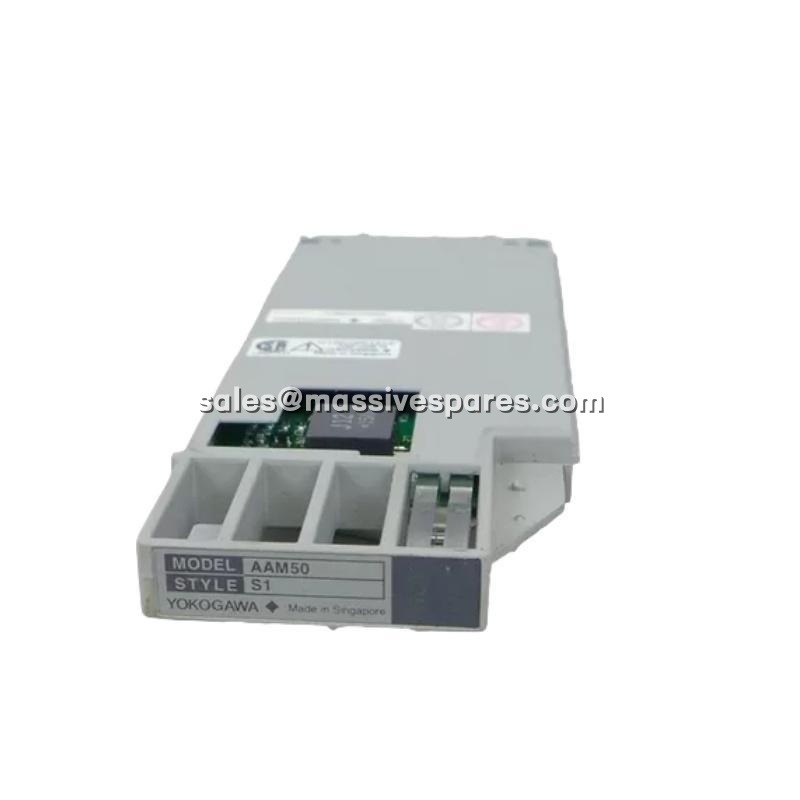
| Product Model | AAM50 |
| Manufacturer | Yokogawa Electric Corporation |
| Product Type | Current Output Module (Analog Output) |
| Number of Output Channels | 8 channels |
| Output Signal | 4–20 mA DC (configurable 1.0–21.5 mA range) |
| Accuracy | ±48 µA |
| Resolution | 16-bit D/A conversion |
| Data Update Period | 20 ms |
| Step Response Time | 100 ms |
| Allowable Load Resistance | 0–750 Ω |
| Output Resistance | 500 kΩ or more |
| Output Voltage Limit | 25.5 V DC or less |
| Output Open Detection | 0.65 mA or less |
| Current Consumption | 250 mA max @ 5.0 V DC |
| Signal Isolation | Output signals isolated from system; 1500 V AC/min withstand voltage |
| Mounting Method | I/O Module Nest (AMN11) |
| Operating Temperature | 0 °C to +55 °C |
| Weight | Approx. 0.4 kg |
| Dimensions (W×H×D) | Approx. 130 × 30 × 100 mm |
Main Features and Advantages
High-Precision 4–20 mA Current Output: The Yokogawa AAM50 delivers an accuracy of ±48 µA across its full output range, ensuring that control valves and other final elements receive commands that are faithful to the controller’s intent. With 16-bit resolution and a 20 ms data update period, the module provides the fine granularity and responsiveness required for tight, stable control loops. The 100 ms step response ensures that setpoint changes propagate to the field device without perceptible delay.
Channel Isolation and Signal Integrity: A defining strength of the AAM50 is its output-to-system galvanic isolation, rated at 1500 V AC for one minute. This prevents electrical faults, ground potential differences, and common-mode noise on one channel from propagating to the controller backplane or adjacent loops. In plants where field devices share different reference grounds—a common scenario in large distributed installations—this isolation is essential for eliminating ground loops and preserving signal fidelity.
Built-In Open-Circuit Detection: The module continuously monitors each output channel and can detect open-circuit conditions when the loop current falls below 0.65 mA. This diagnostic capability allows maintenance teams to identify broken wires, failed terminations, or high-impedance faults before they cause a process deviation or spurious trip. Combined with the module’s stable performance across temperature variations (±32 µA per 10 °C), the AAM50 offers dependable operation even in demanding cabinet environments.
Dual-Redundant Configuration Support: For critical control loops where signal loss is unacceptable, the Yokogawa AAM50 can be configured for dual redundancy. By installing two modules in adjacent odd/even slots and connecting their designated terminals with a shorting bar (part number A1534JT), the system maintains output continuity even if one module fails. This fault-tolerant architecture makes the AAM50 well-suited to safety-relevant and high-availability process applications.
Software-Configurable and Maintenance-Friendly: Output signal type and range are selected through the CENTUM engineering software, eliminating the need for hardware reconfiguration when process requirements change. The module mounts directly into the I/O nest and connects to field wiring via M4 screw terminals, making both initial installation and module replacement straightforward. Its compact 130 × 30 × 100 mm footprint supports high-density installations without compromising serviceability.
Application Field
The Yokogawa AAM50 is deployed wherever a Yokogawa CENTUM DCS needs to send precise analog commands to field-mounted final control elements. Its primary application is driving control valves in process industries—oil refineries, petrochemical plants, power generation facilities, pharmaceutical manufacturing, and water treatment plants all rely on accurate 4–20 mA signals to position valves that regulate flow, pressure, temperature, and level. In these environments, even a small output error can translate into measurable product loss or energy inefficiency, making the AAM50’s ±48 µA accuracy a genuine operational asset.
Beyond valves, the interfaces with I/P converters and pneumatic positioners, variable frequency drives for pump and fan speed control, and damper actuators for combustion air and HVAC systems. It also supports secondary instrumentation such as chart recorders, panel meters, and remote analog indicators—any device that requires a standard 4–20 mA input. In distributed I/O installations, the module’s eight channels can be allocated across multiple loops within a single nest, providing a cost-effective way to expand analog output capacity without adding an entire cabinet.
For plants running legacy CENTUM CS 3000 or CS systems, the Yokogawa AAM50 is particularly valuable as a replacement module during planned shutdowns and emergency maintenance. Because the module is software-configurable and pin-compatible within the AAM nest architecture, a swap can often be completed in minutes, minimizing process disruption. Its availability as a genuine spare part is therefore a key consideration for any facility committed to extending the service life of its existing DCS investment.