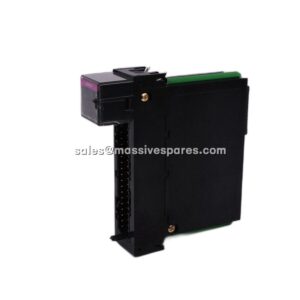
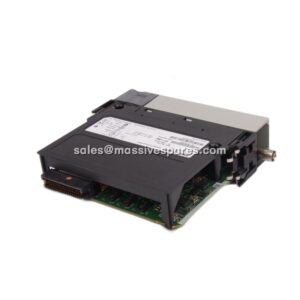
Description
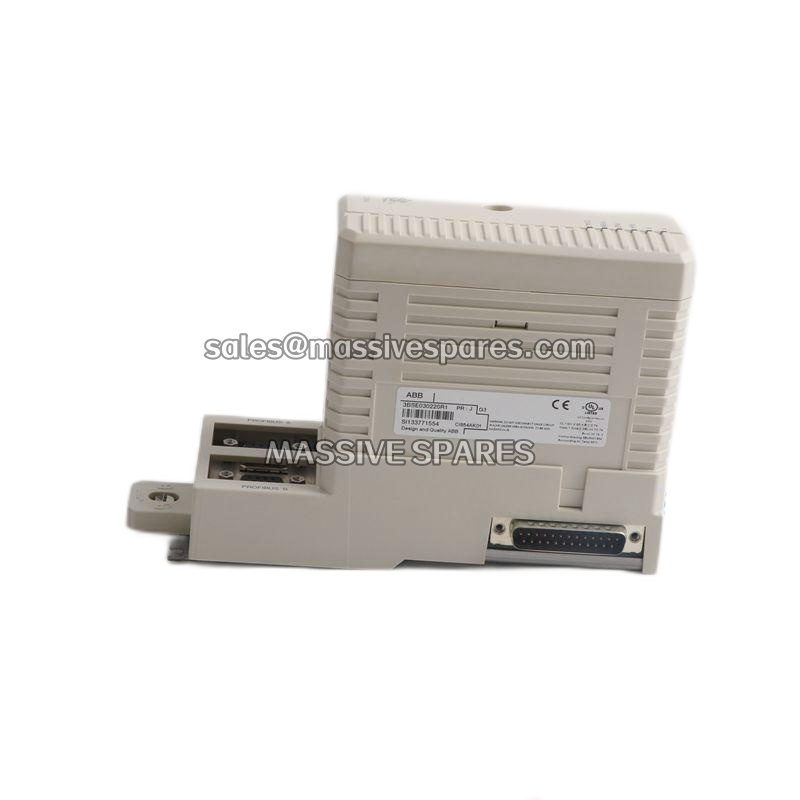
Technical Specifications
| Parameter | Value |
|---|---|
| Product Model | ABB 07KT97 |
| Product Family | Advant Controller 31 basic unit |
| Device Type | Central processing unit |
| User Program Memory | 480 KB Flash EPROM |
| User Data Memory | 256 KB Flash EPROM |
| Digital Inputs | 24 channels in three isolated groups of eight |
| Digital Outputs | 16 transistor outputs in two isolated groups of eight |
| Configurable Digital I/O | 8 electrically isolated channels |
| Analog Inputs | 8 configurable channels |
| Analog Outputs | 4 configurable channels |
| High-Speed Counters | 2 channels, up to 50 kHz |
| System Bus | CS31 for remote I/O and distributed stations |
| Serial Interfaces | COM1 and COM2 for programming and Modbus |
| Real-Time Clock | Integrated, backed by 07 LE 90 lithium battery |
| Memory Extension | SmartMedia Card 07 MC 90 |
| Supply Voltage | 24 V DC |
| Programming Software | 907 AC 1131 |
| Mounting | 35 mm DIN rail or screw mounting |
| Operating Temperature | 0 °C to +55 °C |
Main Features and Advantages
Integrated control and I/O: The ABB 07KT97 reduces cabinet complexity by combining the processor with local analog and digital I/O. Small and medium applications can run without extensive module racks, while larger systems can retain the same CPU and expand through CS31 remote I/O.
Flexible analog signal handling: Eight analog inputs can be individually configured for voltage, current, Pt100, or differential measurements, and can also serve as digital inputs. Four analog outputs support voltage and current ranges, allowing the same controller to handle temperature, pressure, flow, level, and actuator control.
Deterministic processing: The CPU is designed for predictable program execution, with status and error LEDs that simplify startup and fault diagnosis. The integrated high-speed counter responds independently of normal program execution, making the ABB 07KT97 suitable for pulse counting, incremental encoder evaluation, and fast event capture.
Scalable distributed architecture: CS31 allows the basic unit to communicate with remote I/O modules and other AC31 devices. The controller can therefore scale from a compact standalone station to a distributed control system without changing the core processor platform.
Configurable network connectivity: Hardware variants support ARCNET, PROFIBUS-DP, CANopen, and Ethernet. This allows the ABB 07KT97 to integrate with legacy Advant networks or later control and SCADA systems, although the exact interfaces depend on the order suffix.
Program and data protection: User programs reside in nonvolatile Flash EPROM, while the SmartMedia Card provides additional storage for programs, user data, and firmware. The battery preserves the real-time clock and volatile data, but the battery should be replaced proactively during planned maintenance.
Application Field
The ABB 07KT97 is used where an existing Advant Controller 31 system must be maintained, repaired, or replicated. It supports continuous-process control, machine automation, and distributed I/O architectures that were originally engineered around AC31 hardware and 907 AC 1131 programs.
Typical applications include pump and valve sequencing, motor control, temperature regulation, pressure and flow control, dosing systems, conveyor coordination, and packaging-machine logic. The onboard analog channels make it suitable for closed-loop control, while the CS31 bus allows remote I/O to be concentrated near field devices and brought back to a central controller.
The controller is also relevant to power-generation balance-of-plant systems, water and wastewater treatment, building and HVAC controls, and industrial machines where the original control philosophy must be preserved. Because the ABB 07KT97 is obsolete, it is especially valuable for like-for-like spare replacement, emergency repairs, and phased modernization projects that cannot justify rewriting the control application.
Successful deployment depends on matching the replacement variant to the original network interfaces and communication parameters. Programs, SmartMedia Cards, and station addresses must be preserved or properly migrated, and the replacement should be verified against ABB system documentation before returning the plant to automatic operation.