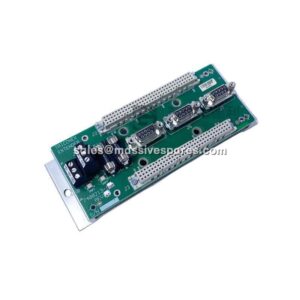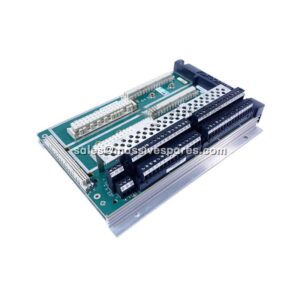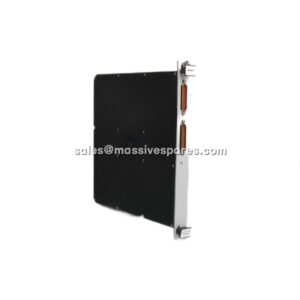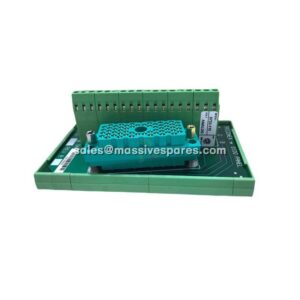

Description
Application Scenarios:
Picture a hydrocracker unit at 03:00, with reactor pressure drifting toward the HIPPS trip point. Every pressure, flow and level vote the Tricon logic solver makes depends on one thing: whether the analog value arriving at the 3700A card is trustworthy. Signal noise, a shared field power supply that sags, or one shorted transmitter loop can push a healthy unit into a spurious shutdown — and a spurious shutdown on a hydrocracker is easily a six-figure event once you count lost production, flare load and restart time.
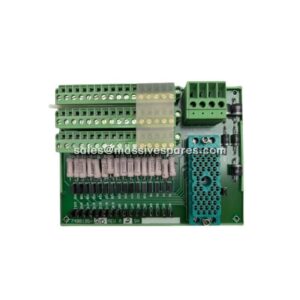
This is precisely the pain the 9771-210 removes. Its per-channel 180 Ω series resistor caps the current a faulted loop can draw, so a single shorted transmitter degrades one point instead of collapsing the common field supply and taking 16 or 32 channels dark. Its precision 250 Ω shunts perform the 4–20 mA to 0–5 VDC conversion on-board, eliminating the external resistor banks, junction-box hacks and calibration drift that maintenance teams otherwise inherit. And because the 9771-210 supports two independent 24 VDC feeds with diode OR-ing, the loss of one distribution leg is invisible to the safety logic — no trip, no alarm flood, no lost shift.
The second scenario is commissioning and turnaround, where the 9771-210 pays for itself in technician hours. Sixteen clearly labelled, front-access screw terminals per panel, with dual label sets (1–16 and 17–32) supplied for use on 32-point modules, turn loop checking into a linear, documented task. Crews can de-terminate, inject, and re-terminate a channel without disturbing its neighbours — which is exactly what you want during a 10-day shutdown window.
Parameter:
| Main Parameters | Value/Description |
|---|---|
| Product Model | 9771-210 |
| Manufacturer | Invensys / Triconex — now Schneider Electric |
| Product Category | Analog input termination panel (ETP), current input type |
| Panel Type | Current input, user-configurable — 16 points per official Tricon field-termination documentation |
| Channel Architecture | 16 current input terminals (−) plus 16 field power output terminals (+); two panels required per 32-point AI module |
| Input Signal Compatibility | 4–20 mA field loops; serves AI modules configured for 0–5 VDC, 0–10 VDC and −5 to +5 VDC |
| Signal Conversion | One precision 250 Ω resistor per input for 4–20 mA → 0–5 VDC conversion — no external shunt hardware |
| Per-Channel Protection | 180 Ω series current-limiting resistor on each positive power terminal, preventing fault propagation to the card |
| Field Power Supply | Redundant 24 VDC inputs with internal diode OR-ing — continuous loop power on single-feed loss |
| Compatible AI Modules | 3700, 3700A (32 pt, TMR, +6% over-range), 3703E (16 pt, isolated), 3721 (32 pt) |
| Wiring Interface | Front-access screw terminals, 12–24 AWG copper; shielded twisted pair with single-point shield ground |
| Environmental Adaptability | −40 °C to +70 °C operating; 5–95% RH non-condensing; rated to the same environmental envelope as the Tricon chassis |
| Installation Method | DIN rail or cabinet backplate mounting; passive board, no firmware or software configuration |
| Physical Data | Approximately 145 × 114 × 108 mm; approximately 0.5–1.0 kg depending on hardware revision |
| Safety Context | Designed for use inside TÜV-certified IEC 61508 SIL 3 Tricon TMR loops (system-level certification) |
One important clarification for buyers: the 9771-210 is a passive field termination panel. It carries no processor, no firmware and no communication protocol of its own — the SIL 3 claim belongs to the Tricon system architecture in which it is installed, and the “user-configurable” designation refers to how the panel’s terminals and resistor network are applied, not to software configuration.
Technical Principles and Innovative Values:
Innovation Point 1: On-board precision conversion instead of marshalling complexity.
Every input of the 9771-210 carries a factory-fitted precision 250 Ω resistor that converts 4–20 mA into the 0–5 VDC window the Tricon AI cards expect. Competing generic terminal blocks hand this job to external, field-mounted resistors — additional parts to specify, purchase, mount, calibrate and eventually drift. Putting the conversion on the panel removes a measurable slice of both capital cost and lifecycle calibration burden.
Innovation Point 2: Per-channel current limiting that contains failures locally.
Each of the 16 positive power terminals on the 9771-210 is protected by a 180 Ω series resistor. A shorted or mis-wired transmitter therefore draws bounded current and affects one channel, rather than browning out the shared field supply and blinding an entire 32-point module. In SIS terms this is the difference between a degraded-channel diagnostic and a process-wide spurious trip.
Innovation Point 3: Diode-OR-ed redundant field power as standard, not as an option.
The 9771-210 accepts two independent 24 VDC feeds and combines them through internal diode OR-ing. Single-distribution-leg failures — blown fuse, failed rectifier, tripped breaker during maintenance — become non-events for the safety loop, which is why this panel is repeatedly specified for ESD, F&G and HIPPS duties where availability and safety have to coexist.
Innovation Point 4: One panel family, four different AI modules, honest scaling.
The 9771-210 is the “user configurable” option in the Tricon termination matrix for 3700A (0–5 VDC), 3703E (0–5 or 0–10 VDC) and 3721 (0–5 V or −5 to +5 V) modules. Because 32-point cards need two panels, each 9771-210 ships with both 1–16 and 17–32 label sets — a small detail that prevents a large class of point-addressing errors during loop checkout.
Innovation Point 5: Controlled signal sharing with a DCS, with the safety boundary explicitly stated.
The 9771-210 supports sharing a single transmitter between the Tricon and another system such as a DCS by removing the relevant jumper. Crucially, the design documentation flags this: sharing may violate the segregation of safety and control functions, so the feature is intended only where that restriction does not apply or is otherwise mitigated. That transparency is worth more to a functional-safety reviewer than a silent capability.