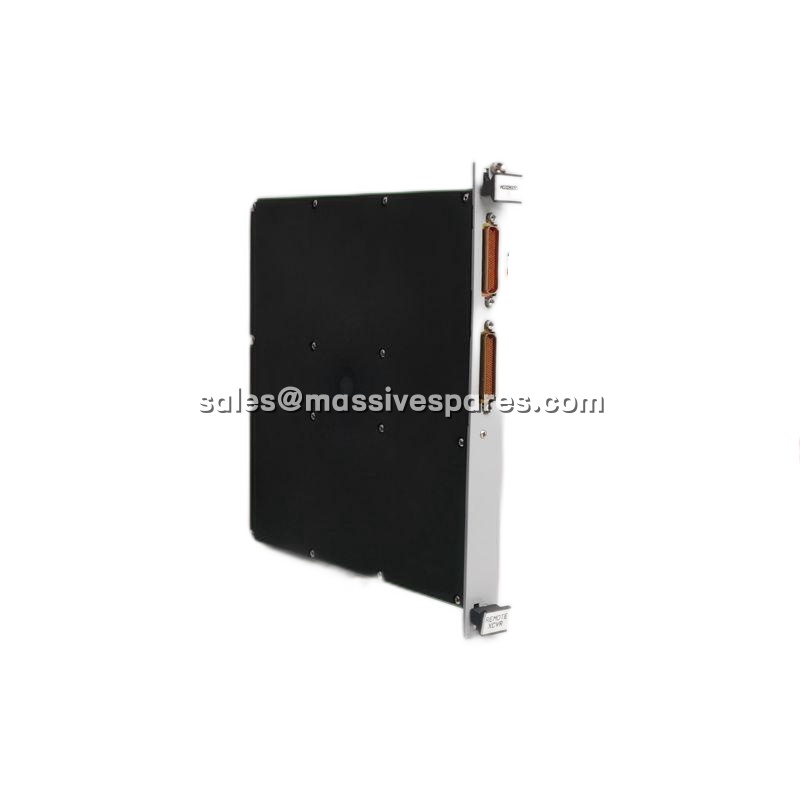

Description
Application Scenarios
In marine diesel generator control systems, multiple generator sets require continuous monitoring of critical parameters including fuel oil pressure, cooling water temperature, and lube oil pressure. Under traditional centralized wiring schemes, sensor signals must travel long distances to the main control cabinet, driving up cable costs while signal attenuation and electromagnetic interference frequently trigger false alarms. A shipyard building a new electric-propulsion vessel deployed WOODWARD 9905-969 modules to form a LinkNet distributed acquisition network, mounting the modules in junction boxes adjacent to each engine. Each 9905-969 connects to the NetCon controller through a single twisted-pair cable on the LinkNet bus, with six 4-20mA input channels simultaneously capturing pressure transmitter and temperature transmitter signals that are transmitted over the bus to the main control system. After the retrofit, engine room cable usage dropped by approximately 40%, signal acquisition accuracy improved markedly, and false alarms previously caused by cable interference were essentially eliminated.
Parameter
| Parameter | Value/Description |
|---|---|
| Product Model | 9905-969 |
| Manufacturer | Woodward |
| Product Category | LinkNet 6-Channel Analog Input Module |
| Input Channels | 6 independent 4-20mA current inputs |
| Input Signal | 4-20mA DC standard industrial current signal |
| Loop Power | 24 VDC loop power, directly supplies two-wire transmitters |
| Power Supply Input | 18-32 VDC |
| Accuracy | 1% @ 25°C |
| Network Protocol | LON-based LinkNet field bus |
| Network Capacity | Up to 4 independent legs per controller, 60 modules per leg, 240 total |
| Address Setting | Dual rotary switches, address range 1-60 |
| Operating Temperature | -40°C to +55°C |
| Dimensions | Approximately 14 × 11 × 4 in |
| Mounting Method | DIN rail mounting |
| Lifecycle Status | Obsolete, retained for legacy system spares |
Technical Principles and Innovative Values
- Innovation Point 1 – Distributed architecture slashes wiring costs: As a LinkNet network node, the 9905-969 communicates with the NetCon controller over a single twisted-pair cable. One NetCon controller manages four independent network legs, each supporting 60 modules, allowing the system to scale to a maximum of 240 LinkNet nodes. This architecture replaces the massive parallel cabling of traditional centralized systems with bus-style connections, dramatically reducing cable costs and installation labor in large machinery trains or distributed equipment groups.
- Innovation Point 2 – Channel-level optical isolation preserves signal integrity: The module incorporates independent optical isolation circuitry for each analog input channel, effectively blocking electromagnetic interference, surges, and potential differences from the field side from penetrating the bus network. In harsh electromagnetic environments such as marine vessels and power plants, this isolation design ensures stable and reliable signal acquisition, preventing misreads or channel faults caused by interference.
- Innovation Point 3 – Dual rotary switch addressing simplifies field commissioning: Each 9905-969 module features two rotary switches for setting the network address (1-60). Field engineers can complete address configuration without specialized programming tools—simply by turning the dials. Combined with communication rate settings configured through MOE encoder software, module integration becomes intuitive and less error-prone.
- Innovation Point 4 – 24V loop power simplifies transmitter wiring: The module includes built-in 24V loop power, enabling direct supply to two-wire pressure transmitters, temperature transmitters, and other field instruments. This means sensor wiring requires no additional dedicated power loops, reducing the number of power modules and wiring complexity—a particularly pronounced advantage in distributed installation scenarios.